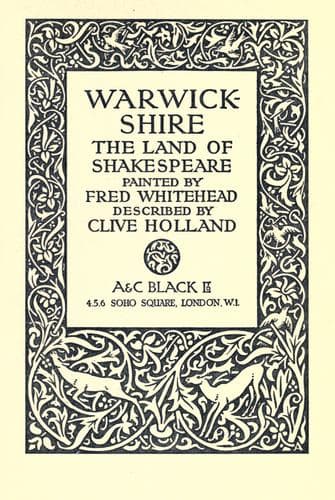
Warwickshire: The Land of Shakespeare — John Shaqi
Warwickshire: The Land of ShakespeareHolland, Clive
History
Warwickshire: The Land of Shakespeare
Holland, Clive
Warwickshire (England) -- Description and travel
The first occupants of this interesting building were Knights
Templars, who were succeeded by the Knights of St. John. After the
Dissolution of Monasteries it fell into the hands of one Anthony
Stoughton, a descendant of whom—Nicholas Stoughton—erected the present
building at the commencement of the seventeenth century. The property
eventually came into the possession of the Warwick family, and still
remains so. The interior of the house is well worth inspection, as it
contains a fine Jacobean oak staircase, and a panelled, tapestry–hung
room.
Of the many churches, stated to have been ten in number, in addition
to the Priory, Nunnery, and other religious houses which existed
in early times, little is known; but two—those of St. Mary and St.
Nicholas—which still survive were, even in the reign of Edward III.,
found to afford sufficient accommodation for the inhabitants of the
town. Indeed, an ancient decree dated 1367 enjoined upon all persons
that they should attend the church of St. Mary. The sites of several
other churches, it is true, are known, but nearly all visible traces
of them have long ago disappeared. Of these aforetime ecclesiastical
buildings the church of St. Michael, in the northern part of the town,
is nowadays a blacksmith’s shop, whilst that of John the Baptist was
formerly near the centre of the market–place, and St. Helen’s was
replaced by the Priory of St. Sepulchre. The church of St. Peter, which
was pulled down in the reign of Henry VI., stood in the middle of
the town, and another dedicated to the same saint was built over the
eastern gate, whilst St. Lawrence’s was situated on the western side.
Of the religious houses few traces remain, all of them having been
dissolved, and many of them entirely pulled down at the date of the
Reformation.
[Illustration: BEAUCHAMP CHAPEL, WARWICK.]
St. Mary’s, the principal and beautiful church, stands upon the site
of a much earlier building, which existed prior to the Conquest, and
was in 1123 made collegiate by the transferring of the Collegiate
Church of All Saints from within the Castle. It is probable that the
present building was either rebuilt or very much enlarged by Roger de
Newburgh in the reign of Henry I. And Thomas de Beauchamp, in the reign
of Edward III., commenced to re–erect the choir; whilst his son, also
Thomas, who succeeded him, completed the rebuilding of the whole church
in 1394. This undertaking had been necessitated by the damage the
building had received from fire during the reign of Stephen. The work
was completed at the end of the fourteenth century; and the chapel of
Our Lady, now generally known as the Beauchamp Chapel, was added during
the middle part of the fifteenth century.
Public-domain text, read in full here on John Shaqi.
Reviews
Reviews
No reviews yet
Be the first to share your thoughts on this work.
Join the Discussion
Join the discussion
Sign in to leave a comment or review.
Sign InorCreate an account