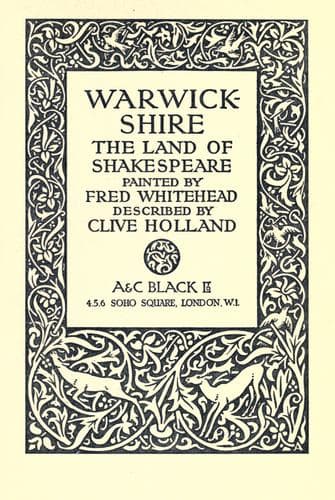
Warwickshire: The Land of ShakespeareHolland, Clive
History
Warwickshire: The Land of Shakespeare
Holland, Clive
Warwickshire (England) -- Description and travel
Under Suetonius Paulinus the domination over this portion of Britain
was extended and ultimately rendered complete. At this period “Arden,”
which is the general Celtic name for a forest, was to all intents
Warwickshire. It certainly was the largest of all British forests, and
extended from the Avon as far northward as the Trent, and probably
stretched to the banks of the Severn on the west. Its eastern
boundary is more uncertain, but there appears considerable reason for
believing that it lay approximately along a line drawn from the town
of Burton–on–Trent to High Cross, where the Fosse–Way and Watling
Street intersect. The early inhabitants of the southern portion of
this thickly–wooded and well–timbered district were principally if
not entirely belonging to the tribe of herdsmen known as the Hwiccian
Ceangi, and this district of Arden was known as the “Feldon,” whilst
the northern portion of the county beyond the Avon was then known
as the Woodland. The first–named district was of the nature of more
open country, with pasture lands and possessing wide cultivated
areas, although well–wooded in places; whilst the second named was
thickly timbered and scarcely penetrated to any extent by the Roman
conquerors. In later times, when England was ultimately divided into
shires or counties, in those of Warwick and Stafford were incorporated
various portions of the wilder Arden of those ancient days. The name
is, however, now only preserved in Warwickshire, where it survives in
Hampton–in–Arden and Henley–in–Arden, situated in the Woodland district.
Partial as the subjection to the Roman yoke of what is now known as
Warwickshire undoubtedly was, considerable remains of the occupation
have from time to time been discovered in the shape of coins,
implements, pottery, and other antiquities at Warwick, Alcester,
Lapworth, Hampton–in–Arden, Milverton, Birmingham, and other places.
The departure of the Romans affected Warwickshire less than some
other portions of the country at first. But there is little doubt that
the usual policy of the conquerors of drafting the bravest, best, and
youngest men into their own legions for service abroad left “the heart
of England” as badly prepared to resist the invasion of other tribes as
was the rest of the country. Depleted of many of its bravest warriors,
England was, after several centuries of reliance upon an alien power
for defence, when the Roman conquerors departed left at the mercy of
any who chose to attack. Not only were all the legions required at
home to resist the Saxon invasion under Alaric, who poured his hosts
of barbarians over the wide–spread Roman Empire, but the British youth
who had been drafted abroad returned not, and thus, as Gildas says,
Britain, despoiled of her soldiers, arms, and youth, who had followed
Maximus to return no more to their native shores, and being ignorant of
the art of war, groaned for many years under the constant incursions
and ruthlessness of the Picts and Scots.
Public-domain text, read in full here on John Shaqi.
Reviews
Reviews
No reviews yet
Be the first to share your thoughts on this work.
Join the Discussion
Join the discussion
Sign in to leave a comment or review.
Sign InorCreate an account