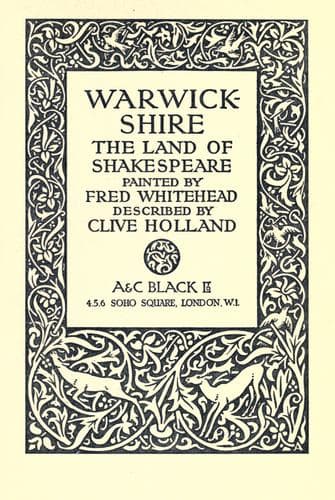
Warwickshire: The Land of ShakespeareHolland, Clive
History
Warwickshire: The Land of Shakespeare
Holland, Clive
Warwickshire (England) -- Description and travel
For some considerable period after the departure of the Romans few
historical records relating to Warwickshire exist. And if, as George
Eliot wrote in _The Mill on the Floss_, “the happiest nations have no
history,” then the county which gave her and the “Bard of Avon” birth
must have been a pleasant spot for a long period. There is probably
a reasonable explanation of this circumstance when its position is
considered. Situated in the centre of England, and far removed from
the seaboard, it naturally escaped much of the storm and stress of
invasion and attack from which less happily placed districts in those
wild, early periods of national history so constantly suffered. Except
for a record that one Credda, a Saxon commander of note, successfully
penetrated into the wooded solitudes of Warwickshire, there are few
data obtainable for the construction of an historic sketch of this
region until the time of the Saxon Heptarchy. Then it became a part and
parcel of the wide–spread kingdom of Mercia, and not only enjoyed a
share of its rule and barbaric pomp and circumstance, but also played
a not inconsiderable part in the wars and feuds of the various Mercian
rulers.
[Illustration: SALFORD PRIORS.]
The capital of several of these monarchs was Tamworth; which anciently
enjoyed the distinction of standing in both Staffordshire and Warwick,
concerning which the Saxon Chronicle of 913 records, “This year, by
the help of God, Æthelflæd, lady of the Mercians, went with all the
Mercians to Tamworth, and there builded a burgh early in the summer.”
In those times Kingsbury, on the Tame, was also a place of importance
as a royal residence, and, according to Dugdale, the farmhouse,
formerly the Hall, stands on the spot where stood the palace of the
Mercian kings. Tamworth was destined to play its part in one of those
fierce and lurid conflicts between the Saxons and the Danish invaders
which took place after the town had been burned by the latter. Near
by, too, in A.D. 757, another battle took place between Ethelbald, the
tenth king of Mercia, and Cuthred, King of the West Saxons, when the
former was slain by one of his own followers. At Seckington, about five
miles to the north–east of Tamworth, is a tumulus, which not only marks
the site of the battle, but also the burial–place of those who fell.
Public-domain text, read in full here on John Shaqi.
Reviews
Reviews
No reviews yet
Be the first to share your thoughts on this work.
Join the Discussion
Join the discussion
Sign in to leave a comment or review.
Sign InorCreate an account