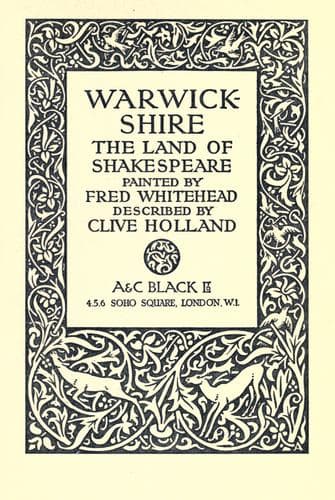
Warwickshire: The Land of ShakespeareHolland, Clive
History
Warwickshire: The Land of Shakespeare
Holland, Clive
Warwickshire (England) -- Description and travel
In 1382 the Guild of the Holy Cross was founded to maintain two priests
at St. Martin’s Church, and was ten years later made a Fraternity
of men and women under the name of “the Bailiffe and Communalite of
Birmingham and other adjacent places for a Chantrie of Priestes, and
services in the Church for the souls of the Founders and all the
Fraternitie.” It also had other and more secular objects. In the year
1545 the lands belonging to it were seized by the Crown, and five years
afterwards were given by Edward VI. for the “Free Grammar School of
King Edward the Sixth, for the Education and Instruction of Children
in Grammar for ever.” The property so arbitrarily acquired was thus
in the end devoted to a useful purpose. At that time it was valued at
£31 : 2 : 10, and this formed the endowment fund of the famous school,
the income of which at the close of 1880 amounted to the large sum of
nearly £22,000, and is now computed to be almost £50,000.
The manor–house and seat of the De Berminghams, not a trace of which
now remains, was situated within a few yards of St. Martin’s Church,
and a little to the west of Digbeth, the site now being occupied by the
prosaic cattle–market of large extent.
Leland speaks of the town at the time of his visit, which took place
in 1538, thus: “The beauty of Birmingham, a good markett towne in the
extreame parts of Warwickshire, is one streete going up alonge almost
from the left rype (bank) of the brook, up a meane hill, by the length
of a quarter of a mile. I saw but one Paroche Church in the towne.”
Camden, who visited Birmingham some half century later, writes of it
as “full of inhabitants, and resounding with hammers and anvils, for
the most of them are smiths.” “The lower part” (of the town), he adds,
“standeth very waterish; the upper riseth with faire buildings.”
Some authorities seem to infer that Birmingham was not noted for its
metal works until a comparatively recent period, but Leland states:
“There be many smithes in the town that used to make knives and all
mannour of cutting tooles, and many loriners that make bittes and a
great many naylors. Soe that a great part of the town is maintained by
smithes whoe have their iron and seacole out of Staffordshire.”
Hutton, Birmingham’s most famous and completest historian of the past,
claims for this city, whose rise has been so phenomenal during the last
half century, that history proves its progress has been continuous,
and that the town has never suffered a decline. But, of course, during
the centuries before Charles II. it was slow, and only notable in
comparison with that of other places.
Public-domain text, read in full here on John Shaqi.
Reviews
Reviews
No reviews yet
Be the first to share your thoughts on this work.
Elsewhere in the archive
Join the Discussion
Join the discussion
Sign in to leave a comment or review.
Sign InorCreate an account