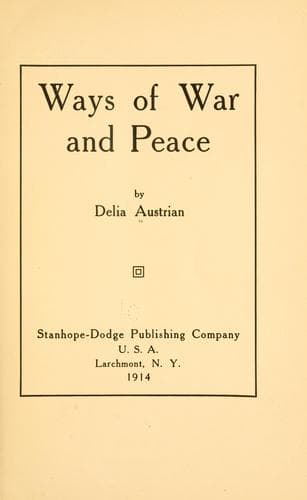
Peace; World War, 1914-1918 -- Personal narratives
Much as you may have read how the European countries have been gathering
their forces, it is all a faint picture compared with the actual
gigantic work that has been taking place during the early periods of the
war.
Until I had seen a small part of this tremendous work, I had always
thought of mobilization as the task of gathering a certain number of
regiments led by their officers, and sending them off with their horses,
cannon and provisions to a point of attack. Though these are all a small
part of a great undertaking, mobilization is a gigantic, living,
breathing, throbbing force, where millions of men may act in concerted
action and still every individual must play a small part in this
melodramatic action.
I was fortunate enough to have been in Germany when the word was sounded
that Russia was mobilizing, and that Germany would do the same unless
Russia gave her some satisfactory explanation for her aggressive action.
When no answer came, at least no satisfactory reply, a declaration was
made that Germany was mobilizing. What did this mean? It meant the
bringing together of the most perfectly trained and equipped military
force of modern times. For just as England has seen to it that she may
retain the proud title of "Commander of the Seas," Germany has been
equally proud of her magnificently equipped military forces.
It may take years to answer the question whether this army was being
organized and trained for aggression to make other nations bow to
Germany's will, or whether the intelligence of the German nation
realized that the issue at stake during the Franco-Prussian War had not
been threshed out and would have to be answered later. For, as Bismarck
said in a conversation with the interviewer, W. B. Richmond, "Germany is
a new empire and it must be protected from possible assault by one or
two or both powers, one to the east, the other to the west of us. You
must remember that the next war between France and Germany must mean
extinction for one. We lie between two lines of fire; France is our
bitter enemy and Russia I do not trust. Peace may be far more
dishonorable than war, and for war we must be prepared. Therefore, while
Germany's very life as a nation is at stake, I cannot give the attention
that I would otherwise wish to as regards the encouragements of the arts
of peace, however much I may believe them to be, as you say, necessary
to the highest development of the nation as a whole."
Public-domain text, read in full here on John Shaqi.
Reviews
Reviews
No reviews yet
Be the first to share your thoughts on this work.
Join the Discussion
Join the discussion
Sign in to leave a comment or review.
Sign InorCreate an account