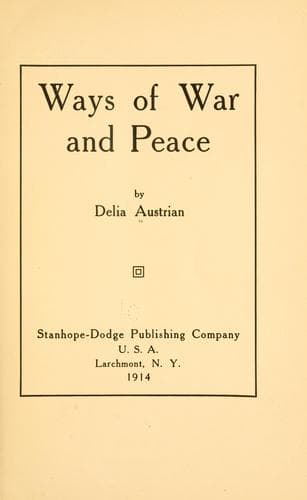
Peace; World War, 1914-1918 -- Personal narratives
The German people of all classes were familiar with this prophecy,
therefore they were not surprised, and more, they were prepared, when
Russia and France in turn threw down the gauntlet of war. In most of the
cities and towns you heard the familiar words spoken by men of all
ranks, "Well, it doesn't matter much; it had to come, today or tomorrow,
only the allies had planned to wait three years longer; then the French
soldiers would have their three years' service and the Russian Army
would have been reorganized. The allies thought that we might be found
napping, but we are pretty well awake, and it is to be a fight to a
finish."
Therefore, when the word mobilization was spoken throughout Germany it
was more than a call. It meant that every boy and man capable of
carrying a gun was more than ready--he was dead anxious to join his
regiment and die for his country. Whatever a man's rank might be,
whatever his daily occupation was, and however responsible the work, he
forgot it all in the eagerness to go to the front. One day I happened to
be in a large bank in Berlin when the president received his call. He
read it as though he were getting an an invitation to a Bankers'
Association banquet instead of its being a call to go to the front. He
had all his affairs in shape to go, and after a short talk with some of
the directors and a friendly goodbye to his associates, he closed his
large rolltop desk, put his hat upon his head and was off.
I chanced to be in a restaurant in Berlin one day when I noticed a group
of soldiers already dressed in their dark gray uniforms drinking their
afternoon coffee and smoking their cigars leisurely. Between the puffs
of smoke, I heard the following conversation: "Shooting down Frenchmen
will be rather different work than singing Sigfried and Tannhauser at a
thousand dollars a night."
"You musn't be so mercenary," answered another. "A campfire and a bed on
the ground will make me appreciate the comforts of a New York hotel
another season, more than the other, while sauerkraut and Wiener wurst
are fair exchange for lobster à la Newburg and chicken patties."
While a third piped up, "I know I will have a more enthusiastic audience
when I sing the Wacht am Rhine to my regiment than I have when I sing
Rigoletto on first nights in New York."
The same enthusiasm was shown by painters, sculptors and writers of all
kinds. What was a thought on paper, on canvas or in stone now compared
with the privilege of doing service for one's country!
While the first regiments were being called out, more than one million
reserves had offered themselves _freiwillig_. They were willing to go
and take any place, even the most dangerous, in any regiment, just as
long as they could serve their country.
Public-domain text, read in full here on John Shaqi.
Reviews
Reviews
No reviews yet
Be the first to share your thoughts on this work.
Join the Discussion
Join the discussion
Sign in to leave a comment or review.
Sign InorCreate an account