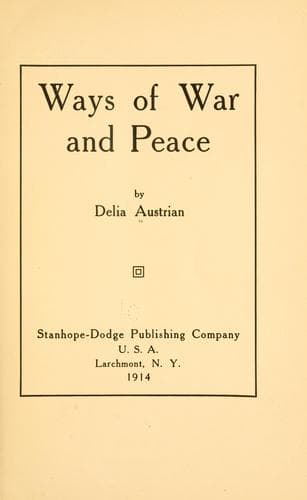
Peace; World War, 1914-1918 -- Personal narratives
One day I met a hairdresser who had two sons; the one had been called
into service and the other had enlisted and was to be called out in two
weeks. When I asked the father if he did not object to having both sons
leave he said, "It is better to have them go than to have them grumbling
every day at home because they cannot help the fatherland."
A few days later I met two young men on a train. They were tired, dirty
and impatient. The explanation for all this was that they had offered
themselves at a neighboring ministry of war and were refused because
there were too many reserves on hand.
About the same time a young girl told me seven of her relatives had been
called into service. One of her brothers-in-law was disqualified, for he
had been hurt while doing his one year military service. Still he was
determined to go, and applied at six different ministries of war before
he was finally accepted to help build up the Landsturm.
More than two-thirds of the great physicians and surgeons of Germany are
in the war. Many of these are volunteers. Those who are too old for
active service are doing their duty in hospitals or in the Red Cross
field. But many who could do this lighter work are fighting in their
regiments. As one well-known German physician said to me, "No, indeed, I
want to go with my regiment. When my country is at peace I am willing to
look after the sick, but now it is time for me to fight. I wish it were
today, for two days seems like two months when a man is ready to go."
I saw another physician work all day until nine o'clock in the evening;
though he had received his commission at seven, he continued his work as
though nothing had happened. Then he gathered a small package of papers
which probably contained important letters and money, which he handed
over to the physician in the institute. He then hurried to his room and
put on his military clothes--they were those of a third-class military
officer. The change in costume seemed to make a different man of him. He
was no longer a physician but a war hero. He bade each one goodbye in
turn, even to the scrub-women, saying he hoped that they would all meet
again next year, and then he hurried to his room to get a few hours of
sleep as he had to leave at five next morning. The only care he had on
his breast was what would become of his mother--a dear old lady of
seventy, whom he loved very much--if anything should happen to him.
One day while walking across the country road, I stepped up to a farmer
and said: "When do you go to the war?"
"Next week," came the blunt reply.
"And who will do your work while you are gone?"
"What's a buxom wife and four sturdy children good for if they can't do
a man's work when he is off at war?"
Public-domain text, read in full here on John Shaqi.
Reviews
Reviews
No reviews yet
Be the first to share your thoughts on this work.
Join the Discussion
Join the discussion
Sign in to leave a comment or review.
Sign InorCreate an account