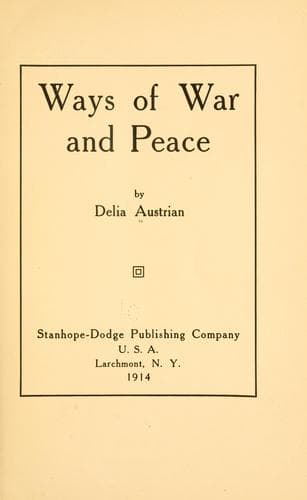
Peace; World War, 1914-1918 -- Personal narratives
When the mobilization was ordered, every farmer brought his horses to
the town, where they were inspected. The horses found strong enough for
battle were taken, and the others were sent back to the farm. The same
thing happened to the automobiles--they were taken without a word of
notice--the government kept those that they wanted and returned the
others.
Though hurrahs, songs and laughter mingled with the tramp of feet as
fifty thousand soldiers formed in line and hurried to the front, this
was only a small part of a great picture. All day long in Berlin we saw
officers flying along in automobiles hurrying to the ministry of war to
get their instructions, and then hastening off to the front. They all
seemed ready and self-reliant.
The nights were not wasted in Berlin, where they were used for
manoeuvres to try out the forty or more Zeppelins which Germany owns.
Even the passenger Zeppelins, known to many Americans for the trips they
made through the Black forest, have been turned into war dirigibles.
Count Zeppelin himself had offered his personal services to take charge
of his invention. It was said new factories were being opened to turn
out two new air-crafts each month. Though the Krupp works at Essen had
been working right along making new siege-guns and special bombs for
Germany, it was said that the factory had put on a large force of men
who were working night and day to make an added supply of ammunition. On
my way from Bavaria to Prussia I saw a number of automobiles flying
across the country carrying their officers to the front. Now and then a
Zeppelin flew overhead practicing before it should venture into France
or Russia.
Most interesting of all were the military trains, forty-two in number,
packed with soldiers and their officers. Though some of them were wedged
so tight they had little moving space, they laughed, smoked, and waved
good-naturedly as they were being hurried across the frontier.
I saw many regiments hurried, at meal-time, into depots. They were led
across into open fields where large, wooden houses with many wooden
benches had been erected. The work was being done under contract, and in
this way thousands of soldiers were fed in a short time.
The baggage cars were crowded with cavalrymen and their horses. Though
their horses and the straw in the car were immaculately clean, these
soldiers were less well off than the infantrymen in the third-class
coupés, for it seemed to me that the horses were getting more than their
share of the room.
Besides these regular coupés, there were many freight cars which carried
all kinds of canned goods and other provisions. Others carried a great
number of small collapsible boats, which are used as pontoons in
crossing rivers. More interesting than all this were the cannons. Some
of these were the common cannons, while now and then loomed a great
siege-gun.
Public-domain text, read in full here on John Shaqi.
Reviews
Reviews
No reviews yet
Be the first to share your thoughts on this work.
Join the Discussion
Join the discussion
Sign in to leave a comment or review.
Sign InorCreate an account