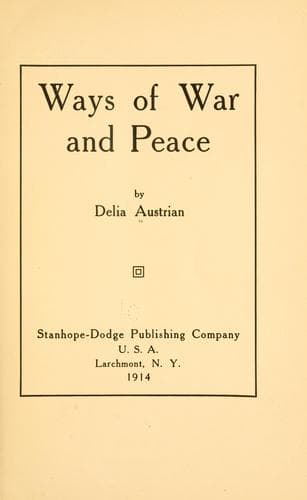
Peace; World War, 1914-1918 -- Personal narratives
The same is true of France, which has the richest fields in the world.
Most of the soil yields two harvests. These farmers take wonderful pride
in their farms and truck-gardens, and when the great painters, Millet
and Corot, dedicated their genius, they found worthy subjects for their
brush. I have traveled through miles of this farmland in France, and its
beauty was a splendid poem of what God had helped man to do. Much of the
rich vineyard and champagne country has been destroyed by war and
neglect, and it will take years of hard toil before it can be repaired.
When this war was less than two months old, whole towns, such as
Louvain, Bruges and Rheims had been laid in waste. This destruction has
meant the loss of thousands of homes, public buildings, churches and
cathedrals, and priceless works of art.
It has also meant the destruction of many miles of railroad, river and
ocean transportation, and the closing of thousands of factories.
It has called forth a sudden demand for certain quantities of
ammunition, horses, wagons, hospital supplies, fuel, food and clothing,
with a great increase in prices on these products.
Credit, which has been the natural and easiest way to carry on business
between individuals and nations, has been put at naught. As a result,
paper and silver have depreciated in value, and people begin to want
gold, for in war gold is the only medium of exchange one can be sure of.
Unfortunately, at the present time, there is not enough gold to do the
world's business, and owners of securities, day after day, have been
trying to sell their stocks and bonds for gold.
In many countries the governments have had to declare moratorium, which
means that none need pay their rent and debts until further notice.
The world's trade has been paralyzed; as a result, most of the stock
exchanges of the world have had to shut down. The New York Stock
Exchange and the Chicago Board of Trade are included in this number,
because if they kept open the foreign countries would exchange their
shares and bonds for gold, and much of our gold would be carried to the
other side.
Because of our added diplomatic responsibilities abroad, we have had to
raise one million dollars, and also two and a half millions for the
Americans stranded on the other side. Many of our factories have closed
because they dealt in a heavy export trade and for which at present
there is no demand. Most noticeable in these trades are the manufactures
of cotton, of metal, agricultural and other machinery, copper and
lubricating oils. Many others of our industries are without the goods
which they import from abroad, including silks, wines, hides and skins,
dyes, nitrate of soda, china, etc.
This war has been such a jar to industrial conditions that many
manufacturers are reducing their daily output considerably, while others
who have a capital are afraid to invest, and are hoarding it in the
banks.
Public-domain text, read in full here on John Shaqi.
Reviews
Reviews
No reviews yet
Be the first to share your thoughts on this work.
Join the Discussion
Join the discussion
Sign in to leave a comment or review.
Sign InorCreate an account