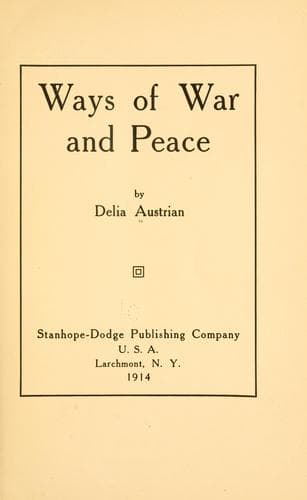
Peace; World War, 1914-1918 -- Personal narratives
Though it is impossible to say how long this war will last, one thing is
sure, the loss to trades the world over is great and will increase as
time goes on. Worse still than the loss of trade and productive labor is
the fact that actual capital is being destroyed, being really burned up.
When the war is over there will be an enormous war debt to pay, and the
loans on money will be high. This destruction of wealth and property
means that many of the countries of the world will be poor for fifty
years at least, and the value of railroad and other stocks in America
and Europe will depreciate.
When the men of the world return to work, there will be a great fall in
prices because of the greater amount of productive work, and it may
result in a fall, at least a temporary fall in wages, though wages will
increase after things are once more established. This war may be a boon
to the financial and industrial life of our country and give us many new
marts of trade in commerce, but while the war lasts it will mean
financial strain and hard times in many industries. It certainly will
cripple European life, civilization and culture for fifty years.
The game of war is a dangerous and expensive one; it means the building
of great war-boats, torpedoes and other submarines, as well as
air-destroyers, along with the manufacture of bombs, mines, powder, etc.
This war shows that the game is being played on such colossal scale that
it may take many millions every year to add to the army, navy and
air-craft. It is not to be forgotten that a great man-of-war costs from
three to five million dollars, and a good torpedo boat many hundred
thousands. The shooting of a cannon ball of a siege-gun means an
expenditure of three thousand dollars for each fire, and it takes four
shots to pierce a heavy fortification. The siege-gun can only be used
about thirty times, and then it is useless. If this game of war is to be
continued, it will mean the burning up of capital, depriving men and
women of every luxury and many necessities for much of the energy of the
world, and no less of the money must be used to that end. Do you not
hear a song more beautiful than the cries and groans of war? Do you not
hear the call of life and creation, the making of more homes and the
caring for those homes? Many hundred years ago men knew the game of war
and practiced it, because they were savages, and in this way earned
their livelihood. It was only after they rose from savages and
barbarians to civilized men that they laid their bows and arrows aside
to cultivate the arts of peace. On all sides are seen results of this
work--in busy factories, in the laying of cables, in the building of
railroads, in their engineering feats, and in the stretching of wires
overhead. Their towns grew until they became cities and capitals, made
splendid by fine pavements and sidewalks, adorned with many handsome
public buildings, gates, fountains, statues, etc. A testimony of all
Public-domain text, read in full here on John Shaqi.
Reviews
Reviews
No reviews yet
Be the first to share your thoughts on this work.
Join the Discussion
Join the discussion
Sign in to leave a comment or review.
Sign InorCreate an account