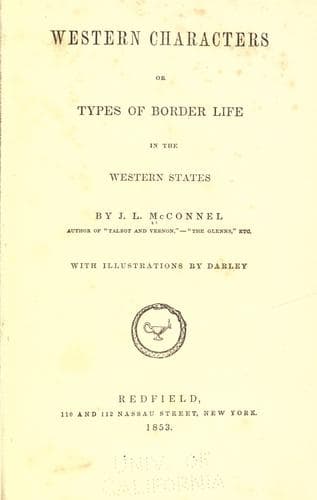
Western Characters; or, Types of Border Life in the Western StatesMcConnel, John Ludlum
General
Western Characters; or, Types of Border Life in the Western States
McConnel, John Ludlum
Frontier and pioneer life -- Mississippi River Valley; Mississippi River Valley -- Social life and customs
Thus--by way of illustration--it might seem, to one not experienced in
reading the signs of progress, a matter of nice speculation and subtle
inquiry, to determine what exact degree of cultivation was necessary, to
make profitable the trade in _clocks_. But I believe there is no
instance of an unsuccessful clock-peddler on record; and, though this
fact may be accounted for, superficially, by asserting that time is
alike important to all men, and a measure of its course, therefore,
always a want, a little reflection will convince us, that this
explanation is more plausible than sound.
It is, perhaps, beyond the capacity of any man, to judge unerringly, by
observation, of the usual signs of progress, the exact point at which a
community, or a man, has arrived in the scale of cultivation; and it may
seem especially difficult, to determine commercially, what precise
articles, of use or ornament, are adapted to the state indicated by
those signs. But that there are such indications, which, if properly
attended to, will be unfailing guides, is not to be denied. Thus, the
quick observation of a clock-peddler would detect among a community of
primitive habits, the growing tendency to regularity of life; for, as
refinement advances, the common affairs of everyday existence, feeling
the influence first, assume a degree of order and arrangement; and from
the display of this improvement, the trader might draw inferences
favorable to his traffic. Eating, for example, as he would perceive, is
done at certain hours of the day--sleep is taken between fixed periods
of the night and morning--especially, public worship--which is one of
the best and surest signs of social advancement--must be held at a time
generally understood.
The peddler might conclude, also, when he saw a glazed window in a
house, that the owner was already possessed of a clock--which, perhaps,
needed repairing--or, at least, was in great need of one, if he had not
yet made the purchase. One of these shrewd "calculators" once told me,
that, when he saw a man with four panes of glass in his house, and no
clock, he either sold him one straightway, or "set him down crazy, or a
screw."
"Have you no other 'signs of promise'"? I asked.
"O yes," he replied, "many! For instance: When I am riding past a
house--(I always ride slowly)--I take a general and particular survey of
the premises--or, as the military men say, I make a _reconnaissance_;
and it must be a very bare place, indeed, if I can not see some 'sign,'
by which to determine, whether the owner needs a clock. If I see the
man, himself, I look at his extremities; and by the appearance of hat
and boot, I make up my opinion as to whether he knows the value of time:
if he wears anything but a cap, I can pretty fairly calculate upon
selling him a clock; and if, to the hat, he has added _boots_, I halt at
once, and, without ceremony, carry a good one in.
Public-domain text, read in full here on John Shaqi.
Reviews
Reviews
No reviews yet
Be the first to share your thoughts on this work.
Elsewhere in the archive
Join the Discussion
Join the discussion
Sign in to leave a comment or review.
Sign InorCreate an account