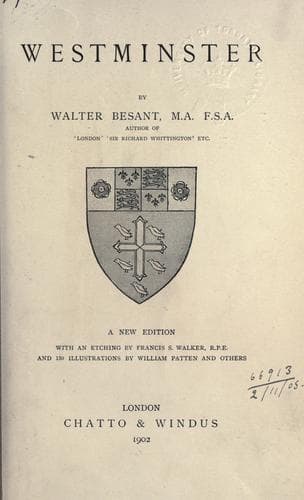
Westminster (London, England) -- Description and travel
The school was first established in Duck Lane, and was instituted by
Thomas Jekyll, D.D., one of the chaplains of the Broadway Chapel. It is
said to have been the first school in the Metropolis supported by
voluntary contributions. It was at first for boys only, but in 1713
twenty girls were included in the scheme, but these were afterwards
dispersed and only the boys retained. Westminster was exceptionally rich
in these foundations of the charitable, both for the young and for the
old.
Further eastward, on the north side of Caxton Street, is the Medical
School in connection with Westminster Hospital. The Town Hall stands
close by. The foundation-stone was laid by the Baroness Burdett-Coutts.
In the muniment-room there are preserved 3,400 records, etc., of
exceptional interest. Here, also, are the St. Ermin's Mansions and
Hotel, which derive their name from St. Ermin's Hill, evidently a
corruption of Hermit's Hill, under which name the place is marked in
some old maps.
Christ Church is of considerable size. It is of the last century (1843),
and its stumpy tower, which is incomplete, gives it an odd appearance.
The church is on the site of the Broadway Chapel, founded by Darrell, a
Prebendary of the Abbey, who in 1631 left L400 for its erection. Various
subscriptions were added to this sum, including one of L100 from
Archbishop Laud. The churchyard had been consecrated in 1626. The chapel
was opened 1642, and saw many vicissitudes of fortune. During the Civil
War it was used as a stable for the soldiers' horses, and at other
times as a council-room and a prison. In the churchyard Sir William
Waller, the Parliamentary General, is buried.
York Street was named after Frederick, Duke of York, son of George II.,
who resided here temporarily. Previously it had been called Petty
France, from the number of French refugees and merchants who inhabited
it. Milton lived in No. 19, now destroyed. The house belonged to Jeremy
Bentham, and was afterwards occupied by Hazlitt, who caused a tablet
bearing the words "Sacred to Milton, Prince of Poets," to be placed on
the outside wall in memory of his famous predecessor.
Public-domain text, read in full here on John Shaqi.
Reviews
Reviews
No reviews yet
Be the first to share your thoughts on this work.
Join the Discussion
Join the discussion
Sign in to leave a comment or review.
Sign InorCreate an account