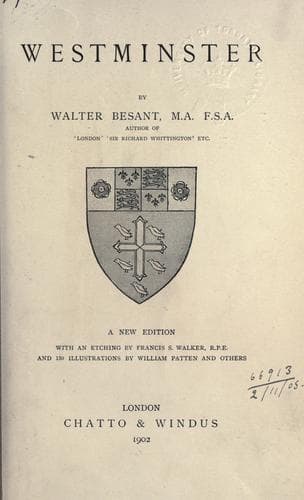
Westminster (London, England) -- Description and travel
Milton came here in 1651, when turned out of chambers in Scotland Yard
which had been allowed him as Latin Secretary to the Council. He still
retained the office. He had lost the sight of one eye, and two years
later was totally blind. He was obliged to have an assistant-secretary,
a post occupied for some time by Andrew Marvell. His daughter Deborah
was born here, and his wife died soon after. In Palmer's Passage,
Palmer's Almshouses were first established, and in Little Chapel Street,
Mr. Nicholas Butler's. Mr. Cornelius Vandon's (Van Dun) were in Petty
France. "Cornelius Vandon was born at Breda in Brabant, Yeoman of the
Guard and Usher to their Majesties Henry VIII., King Edward VI., Queen
Marie and Queen Elizabeth. He did give eight almshouses in Pettie France
next to the end of James Street for the use of eight poor Women of the
Parish. He did also give eight other Almshouses near St. Ermin's Hill by
Tuttle side for the use of eight poor widows of this Parish." These
eight women were intended to act as charity nurses, and to nurse any who
were sick in the parish.
In 1850 the almshouses and ground were sold, and the proceeds devoted to
Vandon's Charity Account. Part of the funds was used to purchase a plot
of ground in Lambeth, where new almshouses were erected, and after the
death of the recipients of the charity these were let to tenants, and
the proceeds devoted to supplying nurses for the poor.
The towering blocks of Queen Anne's Mansions, the highest flats in
London, rear themselves at the east end of York Street. These are partly
on the site of a house occupied for very many years by Jeremy Bentham
(see p. 32).
The Guards Barracks, known as the Wellington Barracks, face Birdcage
Walk. They were opened in March, 1834, and enlarged in 1859. The long
line of yellow-washed building differs little from the usually-accepted
barrack model.
At the east end of the barrack yard stands the chapel, with an
extraordinarily massive portico. It was built in 1839-40 on the model of
a Grecian temple. The building is well proportioned, but the interior
was not at first thought worthy of the exterior. Accordingly, in 1877
the chapel was closed, and a sum of money arising from the sale of the
Guards' Institute was devoted to the purpose of a complete internal
reconstruction. The work was put into the hands of Sir G. E. Street,
R.A., who carried it out in the Lombardian style, with an apse at the
eastern end, and over the apse a semi-dome.
Public-domain text, read in full here on John Shaqi.
Reviews
Reviews
No reviews yet
Be the first to share your thoughts on this work.
Join the Discussion
Join the discussion
Sign in to leave a comment or review.
Sign InorCreate an account