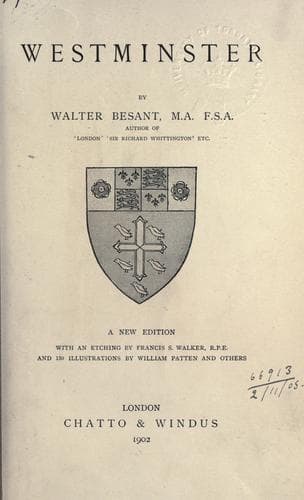
Westminster (London, England) -- Description and travel
The kindly earth covers up and preserves many precious
secrets,--“underground,” says Rabelais, “are all great treasures and
wonderful things,”--to be revealed at some fitting time, when men’s
minds shall be prepared to receive them. The earth preserves, for
instance, the history of the ancient world--witness the revelations in
our own time of the cuneiform tablets and the vast extension of the
historic age: the arts of the ancient world, and their houses, and their
manner of life--witness the revelations of Pompeii. Applied to Thorney,
excavation has shown--what we certainly never could have known
otherwise--that here, of all places in the world, in this little
secluded islet in the midst of marshes (the most unlikely spot, one
would think, in the whole of Britannia), there was a Roman station, and
one of considerable importance. The first hint of this fact was
suggested when there was dug up in the North Green of the Abbey, in the
year 1869, a fine Roman sarcophagus inscribed with the name of Valerius
Amandinus. The lid has a cross upon it, from which it has been
conjectured that the sarcophagus was used twice, its second occupant
having been a Christian. What reason, however, is there for supposing
that Valerius Amandinus himself was not a Christian?--for, at least a
century before the withdrawing of the Legions, Roman Britain was wholly
Christian. For more than two centuries Christians had been numerous.
During the fourth century the country was covered with monastic
foundations for monks and nuns. Christian or not, there stands the
sarcophagus of Valerius Amandinus, for all the world to see, at the
entrance of the Chapter-house; and why a Roman cemetery should be
established in Thorney no one could guess. But some ten years ago there
was a second discovery. In digging a grave under the pavement of the
nave, there was found a mosaic floor in very fair condition. This must
have belonged to a Roman villa. But, if one villa, why not more? The
question has been settled by the discovery, of late years, wherever the
ground on Thorney has been opened, of Roman bricks and fragments of
Roman buildings. It is now impossible to doubt the existence here of a
Roman station.
That is, so far, the (unfinished) evidence of excavation.
But why did the Romans place a station, an important station, on this
bit of a bramble-covered eyot, with a shallow river in front and a
marshy backwater behind? What strategic importance could be attached to
such a spot? The next branch of evidence will serve to answer the
question.
3. _Evidence of Ancient Monuments._
There are here none of those shapeless mounds of ancient ruins which are
found elsewhere--as in Egypt. Nor are there any foundations above
ground, as at Silchester. Yet there is one fact of capital importance,
which not only serves to explain why the Romans established a station on
Thorney, but also illustrates, as we shall see, many other facts in the
history of the island. It is this:
Public-domain text, read in full here on John Shaqi.
Reviews
Reviews
No reviews yet
Be the first to share your thoughts on this work.
Join the Discussion
Join the discussion
Sign in to leave a comment or review.
Sign InorCreate an account