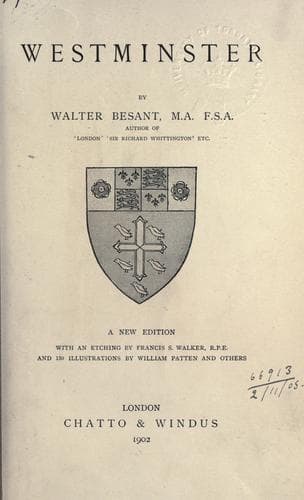
Westminster (London, England) -- Description and travel
We write under the shadow of the Abbey: the bells peal out over our
heads; the organ swells and dies; within the walls are the coffins and
the bones of dead kings and princes and nobles. The air is ecclesiastic:
we may talk of changed hearts and repentant age. The age of civil wars,
intestine wars,--the worst wars of all, the wars of those who speak the
same language,--lasted for five hundred years after the death of King
Cnut. We who belong to a generation which has learned some self-control,
cannot realize the intensity, the strength of the passions which
devoured and maddened the kings of old. The things which make history
dreadful: the murders, the cry to arms at the least provocation; the
cruel disregard of innocent suffering; the wasting, pillaging,
destroying of lands and fields and villages and towns, in blind revenge;
the blinding and torturing and maiming of which every page is full,
these things mean the rage of kings, the revenge of kings upon their
enemies. Cnut in his last years had no enemies; he had killed them all.
Then there were no more rages; he suffered his head to dwell upon nobler
things--in modern language, he “got religion.” And so, at the end of
this Prologue to the Westminster Play, we see the King taking off his
blood-stained ermine, laying down the sword which has set free so many
unwilling souls, and walking in meditation and godly discourse under the
quiet cloisters of the Abbey. Outside, the noisy court and camp; within,
the calm and peace of the religious life. The picture strikes a note of
what is to follow when we pass into the period of history written from
day to day, and draw up the curtain for the Pageant, Mystery, or Play of
Westminster.
CHAPTER II.
THE KING’S PALACE OF WESTMINSTER.
The kings of England held their Court in the Old Palace, the Palace of
Westminster, for five hundred years. Of all the buildings which formed
that Palace, there remain at this day nothing but a Hall, greatly
altered, a Crypt, and a single Tower. Sixty years ago, before the last
of the many fires which attacked the Palace, there was left, much
disfigured, a single group of buildings which formerly contained the
heart of the Palace, the king’s House. This group, however, was so much
shut in and surrounded with modern houses, courts, offices, taverns, and
stores, that the ancient parts could be with difficulty detached.
Fortunately this task was accomplished before the fire: one can
therefore restore one part, at least, of the Palace.
Public-domain text, read in full here on John Shaqi.
Reviews
Reviews
No reviews yet
Be the first to share your thoughts on this work.
Join the Discussion
Join the discussion
Sign in to leave a comment or review.
Sign InorCreate an account