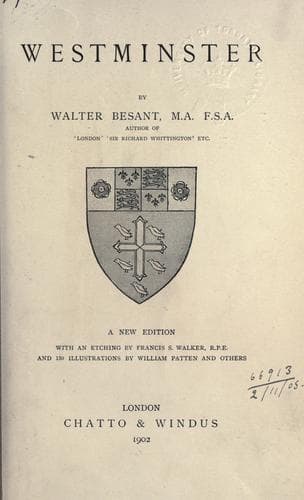
Westminster (London, England) -- Description and travel
In considering the Palace of Westminster, we have the choice, as regards
time, of any year we please between the accession of Edward the
Confessor and the removal of Henry VIII. to York House. Let us take the
close of the fourteenth century; let us attempt to restore the Palace as
it was in the reign of Richard II. It was a time when that shadowy,
intangible force called Chivalry was most active. Yet at best it was
never stronger than its successor, which we now call Honor. Chivalry
taught loyalty, even unto death; protection of the weak; respect for
women; fidelity in love; mercy to the conquered; charity to the poor;
obedience to the Church; fidelity to the spoken word--you may find these
teachings in the pages of Froissart. Knights who obey these precepts are
greatly extolled by poets; yet the opposites of these things are
continually reported by historians. I think that we may roughly, but
certainly, ascertain the chief besetting sins of any age by looking for
the contraries, which will be the things which preachers and poets do
mostly extol.
It has been remarked that antiquarians are prone to fall into the
incurable vice of looking at the past through the wrong end of the
telescope. This comes from constantly endeavoring to reconstruct the
past out of an insufficient number of fragments. Of course the result is
that everything is reduced in size. Thus, many antiquarians, being
afflicted with this disease, have found themselves unable to see
anything but a collection of miserable hovels in that London of the
fourteenth century which was a city of nobles’ palaces, merchants’
stately houses, splendid churches, monastic buildings, beautiful and
lofty, side by side with warehouses, wharves, ships riding at anchor,
crowded streets, and rich shops. No antiquary, however, is wrong in
showing that Westminster was, at this time, nothing more than a City--as
yet not called a City--gathered round the Church and the Court. To those
who journeyed thither from London by the river highway, a line of noble
houses faced the river, each with its stairs, its barges, and its water
gate. Thus, taking boat at Queenhithe, the traveler passed, among
others, Baynard’s Castle, Blackfriars’ Abbey, Bridewell Palace,
Whitefriars, the Temple, Durham House, the Savoy, York House, before he
reached the King’s Stairs at Westminster. At the back of these houses,
where is now Fleet Street and the Strand, there were no houses in the
fourteenth century, except just outside Ludgate. As late as 1543,
according to the map of Anthony van den Wyngreede, the houses of
Westminster were all gathered together in that little triangle opposite
Westminster Hall, whose northern boundary was the stream running down
Gardener’s Lane and cutting off Thorney. All beyond was open country
lying in fields and meadows.
Public-domain text, read in full here on John Shaqi.
Reviews
Reviews
No reviews yet
Be the first to share your thoughts on this work.
Join the Discussion
Join the discussion
Sign in to leave a comment or review.
Sign InorCreate an account