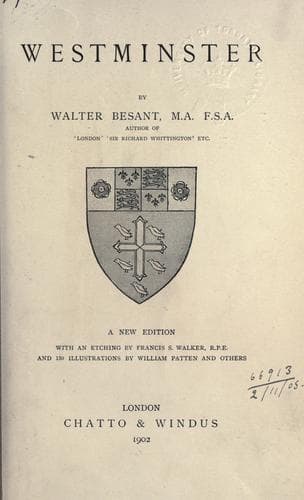
Westminster (London, England) -- Description and travel
“That night there was high revelry in the Palace; the mummers and the
minstrels and the music made the Court merry; and the dancing girls
moved the hearts of the young men. And the King’s Fool made the
courtiers laugh when he jested about the Duke’s amazement and the
Archbishop’s discomfiture. And as for me, plain Francis the scribe, I am
inclined, seeing the miseries that have since fallen upon that most
puissant Prince and upon this country, to humble myself and to
acknowledge the mercy of Heaven in refusing me a higher place than this
of scribe. The Kings succeed; the council changes; the ax and the block
are always doing their work; but the scribe remains, and were it not for
the stiffness of this right knee and a growing deafness, I should have
but little cause for complaint.”
Here ends the manuscript of Francis de Winchelsea.
When the King’s House was removed from Westminster to Whitehall the
importance of the old Palace suffered little diminution. St. Stephen’s
was dissolved, but the chapel was not destroyed nor were the cloisters
broken down. The Commons came across the road, leaving the Chapter House
and exchanging one lovely building for another. They proceeded so to
alter and to rebuild and add and subtract that by the time of the fire
there was not much left of the old St. Stephen’s. The other buildings of
the Palace were gradually modernized, so that in the end little was left
of the old Palace except the nest of chambers that belonged in the first
instance to Edward the Confessor, with the Hall of Rufus. As for this
mediæval Palace, with its narrow lanes, its close courts, its corridors
and cloisters, its lancet windows, its tourelles, its carved work--all
that was gone, never to be replaced. But a good deal of history, a great
many events, had to take place on this site before the building of the
present House of Parliament, which is the greatest change of all. I set
out in these chapters with the desire not to repeat, more than was
necessary, stories that have been told over and over again. It is not
always possible to avoid this repetition, since things must be related
if only to avoid a probable charge of ignorance. Some things can be
avoided as belonging rather to the History of the Nation than the
History of Westminster. Among such things are the rise and development
of the House of Commons. Some things again may be avoided as having been
told so often that no one is ignorant of them; such as the death of
Henry the Fourth in the Jerusalem Chamber. In what follows, chiefly
concerning the Palace after its desertion by the King, there will be
found some things well known to everybody, some things half known, some
things not known at all.
Public-domain text, read in full here on John Shaqi.
Reviews
Reviews
No reviews yet
Be the first to share your thoughts on this work.
Join the Discussion
Join the discussion
Sign in to leave a comment or review.
Sign InorCreate an account