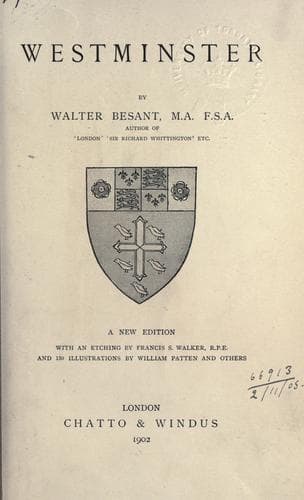
Westminster (London, England) -- Description and travel
In the Old Palace Yard, the open court belonging to the first Palace,
many functions took place; tournaments, executions, trials by battle. At
one of these tournaments, that of 1348, two Scottish knights, the Earl
Douglas and Sir William Douglas, prisoners of war, acquitted themselves
so valiantly that the King sent them home free. Of executions in Old
Palace Yard there is recorded the hanging of a man for slaying another
within the Palace; his body, for an example, remained hanging for two
days. Of trial by battle, many are recorded in Tothill Fields and
elsewhere, and those of Old Palace Yard. One of these was held in the
presence of King Edward III., between Thomas de la Marche and John de
Visconti, to prove that the former had not been guilty of treachery
against the King of Sicily. De la Marche unhorsed his opponent and
struck him in the face as he fell. It is not stated what became of the
wounded man.
On the south side of the Old Palace Yard were certain fish ponds, or
stew ponds, which were kept stocked with eels and pike. On the east side
Geoffrey Chaucer, for a very short time,--less than a year,--occupied a
house. It stood nigh to the White Rose tavern, abutting on the old Lady
Chapel. King Henry the Seventh’s Chapel now occupies the site. And there
was a gateway or passage from the Abbey churchyard to Old Palace Yard,
over which was a house sacred to the memory of Ben Jonson, who lived
there.
In the southeast corner of Old Palace Yard stood the house which was
hired by Percy, one of the conspirators of the Gunpowder Plot, through
which the barrels of powder were conveyed to the vaults. In Palace Yard
four of the conspirators, Guy Fawkes, Thomas Winter, Ambrose Rokewood,
and Robert Keyes were executed fifteen years later, to the shame and
dishonor of the English nation. Raleigh was brought to Old Palace Yard
to die. The day chosen for his execution was Lord Mayor’s Day, so that
the crowd should be drawn to the pageant rather than the execution. It
is curious to read how Lady Raleigh attended at the execution and
carried away the head in a bag. She kept it during the rest of her life,
and after her death it was kept by her son Carew. The body lies buried
in the Chancel of St. Margaret’s.
The memory of these great mobs closes the history of Old Palace Yard.
One of these was in 1641, when six thousand citizens, armed with swords
and clubs, seized on the entrance to the House of Lords and called for
justice against Lord Strafford. The second, in 1773, when the Sheriff
and Aldermen and Common Council of London, in a procession of two
hundred carriages, attended by a huge mob, went to Westminster to
petition against the Excise scheme of Sir Robert Walpole. The third is
the mob that followed Lord George Gordon. On this occasion both Lords
and Commons found it necessary to adjourn.
Public-domain text, read in full here on John Shaqi.
Reviews
Reviews
No reviews yet
Be the first to share your thoughts on this work.
Join the Discussion
Join the discussion
Sign in to leave a comment or review.
Sign InorCreate an account