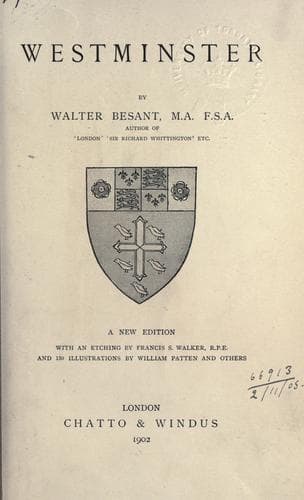
Westminster (London, England) -- Description and travel
[Illustration: WESTMINSTER.]
CHAPTER I.
THE BEGINNINGS.
He who considers the history of Westminster presently observes with
surprise that he is reading about a city which has no citizens. In this
respect Westminster is alone among cities and towns of the
English-speaking race; she has had no citizens. Residents she has
had,--tenants, lodgers, subjects, sojourners within her boundaries,--but
no citizens. The sister city within sight, and almost within hearing,
can show an unequaled roll of civic worthies, animated from the
beginning by an unparalleled tenacity of purpose, clearly seeing and
understanding what they wanted, and why, and how they could obtain their
desire. This knowledge had been handed down from father to son.
Freedom, self-government, corporations, guilds, brotherhoods,
privileges, safety, and order--all have been achieved and assured by
means of this tenacity and this clear understanding of what was wanted.
Westminster has never possessed any of these things. For the City of
London these achievements were rendered possible by the existence of one
single institution: the Folk’s Mote--the Parliament of the People.
Westminster never possessed that institution. The history of London is a
long and dramatic panorama, full of _tableaux_, animated scenes,
dramatic episodes, tragedies, and victories. In every generation there
stands out one great citizen, strong and clear-eyed, whom the people
follow: he is a picturesque figure, lifted high above the roaring,
turbulent, surging crowd, whom he alone can govern. In Westminster there
is no such citizen, and there is no such crowd. Only once in its
history, until the eighteenth century, do we light upon the Westminster
folk. Perhaps there have been, here and there, among them some mute
inglorious Whittington--some unknown Gresham. Alas! there was no Folk’s
Mote,--without a Folk’s Mote nothing could be done,--and so their
possible leaders sank into the grave in silence and oblivion. Why was
there no Folk’s Mote? Because the land on which Westminster stood, the
land all around, north, west, south,--how broad a domain we shall
presently discover,--belonged to the Church, and was ruled by the Abbot.
Where the Abbot was king there was no room for the rule of the people.
Nor could there be any demand in Westminster for free institutions,
because there were no trades and no industries. A wool staple there was,
certainly, which fluctuated in importance, but was never to be compared
with any of the great city trades. And Westminster was not a port; she
had no quays or warehouses: neither exports nor imports--save only the
wool--passed through her hands. There was no necessity at any time for
the people who might at that time be her tenants to demand corporate
action. Westminster has never attracted or invited immigrants or
settlers.
Public-domain text, read in full here on John Shaqi.
Reviews
Reviews
No reviews yet
Be the first to share your thoughts on this work.
Join the Discussion
Join the discussion
Sign in to leave a comment or review.
Sign InorCreate an account