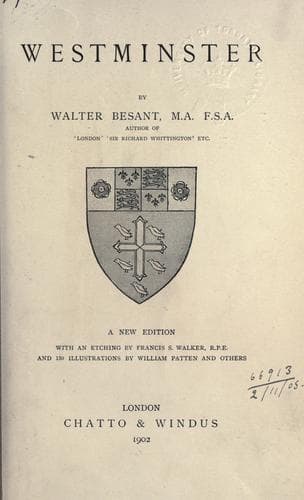
Westminster (London, England) -- Description and travel
Again, a considerable portion of those who lived in Westminster were
criminals or debtors taking advantage of sanctuary. The privilege of
sanctuary plays an important part in the history of Westminster. It is
not, however, from sanctuary birds that one would expect a desire for
order and free institutions. Better the rule of the Abbot with safety,
than freedom of government and the certainty of gallows and
whipping-post therewith.
We may consider that for five hundred years the Court and the Church,
the Palace and the Abbey, divided between them the whole of Thorney
Island. Until, therefore, the swamps were drained, there was no
place--or a very narrow place--for houses and inhabitants on the south
and west. Toward the north, between New Palace Yard and Charing Cross,
houses began and grew, but quite slowly. Even so recently as the year
1755 the parish of St. Margaret’s had extended westward no farther than
to include the streets called Pye Street, Orchard Street, Tothill
Street, and Petty France, now York Street. King Street was the main
street connecting Westminster with London by way of Charing Cross; and
east and west of King Street, at the Westminster or southern end, was a
network of narrow streets, courts, and slums, a few of which still exist
to show what Westminster of the Tudors and the Stuarts used to be.
After the Dissolution--though the Dean succeeded the Abbot--there was
some concession in the direction of popular government. The Dean still
continued to be the over-lord. He appointed a High Sheriff, who in his
turn appointed a Deputy; the city was divided into wards, in imitation
of London, with a burgess to represent each ward. The court thus formed
possessed considerable powers of police; but neither in authority, nor
in power, nor in dignity, could such a chamber be compared with the
Court of Aldermen of London. Edward VI. granted two members of
Parliament to the City of Westminster.
Another reason which hindered the advance of the city in the last
century was that the Dean and Chapter would neither sell their lands nor
grant long leases. Therefore no one would build good houses, and the
vicinity of the Abbey remained covered with mean tenements and populated
by the scum and refuse.
Public-domain text, read in full here on John Shaqi.
Reviews
Reviews
No reviews yet
Be the first to share your thoughts on this work.
Join the Discussion
Join the discussion
Sign in to leave a comment or review.
Sign InorCreate an account