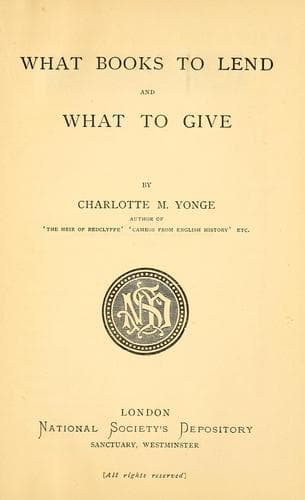
What books to lend and what to giveYonge, Charlotte M. (Charlotte Mary)
General
What books to lend and what to give
Yonge, Charlotte M. (Charlotte Mary)
Books and reading -- Great Britain; Children's literature -- Bibliography
CHURCH HISTORY 99
NATURAL HISTORY 101
SCIENCE AND INVENTION 104
RELIGIOUS BOOKS 106
MAGAZINES 108
PENNY READINGS 111
INDEX 117
[Illustration]
[Illustration]
WHAT BOOKS TO LEND
AND
WHAT TO GIVE.
INTRODUCTION.
Wholesome and amusing literature has become almost a necessity among the
appliances of parish work. The power of reading leads, in most cases, to
the craving for books. If good be not provided, evil will be only too
easily found, and it is absolutely necessary to raise the taste so as to
lead to a voluntary avoidance of the profane and disgusting.
Books of a superior class are the only means of such cultivation. It
has been found that where really able and interesting literature is to
be had, there is much less disposition to prey upon garbage. And the
school lessons on English have this effect, that they make book-language
comprehensible far more widely than has hitherto been the case.
A library is an almost indispensable adjunct to a school, if the children
are to be lured to stay at home instead of playing questionable games in
the dark, or by gaslight, out of doors; and an amusing story is the best
chance of their not exasperating the weary father with noise. If the
boy is not to betake himself to ‘Jack Sheppard’ literature, he must be
beguiled by wholesome adventure. If the girl is not to study the ‘penny
dreadful,’ her notions must be refined by the tale of high romance or
pure pathos.
The children at school are often eager readers, especially if they have
sensible parents who forbid roaming about in the evening. There ought
always to be a school library unless the children are provided for in
the general parish library; but even this requires careful selection.
Weak, dull, or unnatural books may be absolutely harmful when falling
into rude or scornful hands. For instance, a country lad should not
have a book where a farmer gives a prize for climbing an elm-tree to
take a blackbird’s nest, such a proceeding being equally against the
nature of farmers, blackbirds, and elms. Seafaring lads should not have
incorrectly worded accounts of wrecks; and where more serious matters
come in, there should be still greater care to be strong, true, and real.
Boys especially should not have childish tales with weak morality or
‘washy’ piety; but should have heroism and nobleness kept before their
eyes; and learn to despise all that is untruthful or cowardly and to
respect womanhood. True manhood needs, above all earthly qualities, to
be impressed on them, and books of example (not precept) with heroes,
whose sentiments they admire, may always raise their tone, sometimes
individually, sometimes collectively.
Public-domain text, read in full here on John Shaqi.
Reviews
Reviews
No reviews yet
Be the first to share your thoughts on this work.
Join the Discussion
Join the discussion
Sign in to leave a comment or review.
Sign InorCreate an account