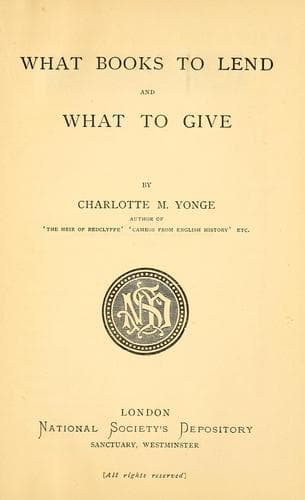
What books to lend and what to giveYonge, Charlotte M. (Charlotte Mary)
General
What books to lend and what to give
Yonge, Charlotte M. (Charlotte Mary)
Books and reading -- Great Britain; Children's literature -- Bibliography
Men, however, must have manly books. Real solid literature alone will
arrest their attention. They grudge the trouble of reading what they do
not accept as truth, unless it is some book whose fame has reached their
ears, and to have read which they regard as an achievement.
Where grown men are subscribers to a library, it should have standard
works of well-known reputation.
Travels, biographies, not too long, poetry, histories of contemporaneous
events, and fiction of the kind that may be called classical, should be
the staple for them. It is hardly advisable to attempt to give a list
for them. Their books belong to general literature, with which I do not
wish to meddle, and besides, reading men mostly inhabit towns where
there are generally Institutes from which they can obtain books. In the
country, when the clever cobbler or gardener soars above the village
library, he will generally have a decided notion of what he wants, and
will respect a special loan from our own shelves. He may take to some
line in natural science, or have some personal cause for interest in a
colony; but in general, the labourer would rather smoke than read in his
hours of rest, and even when laid aside in a hospital, newspaper scraps
pasted into a book are often more welcome to him than more continuous
subjects. Above all, he resents being _written down to_ or laughed at;
and calling him Hodge and Chawbacon is the sure way to alienate him.
Books with strong imitations of dialect are to be avoided. They are
almost unintelligible to those who know the look of a word in its right
spelling, though they might miscall it, and do not recognise it when
phonetically travestied to imitate a local dialect, as for instance by
_ah_ for _I_. Moreover, they feel it a caricature of their language, and
are very reasonably insulted. They do not appreciate simplicity, but are
in the stage of civilisation when long words are rather preferred, partly
as a compliment, partly as a new language. Complicated phrases are often
too much for them, but polysyllables need not be avoided, if such are
really needed to express an idea, and will do it better than any shorter
word.
Public-domain text, read in full here on John Shaqi.
Reviews
Reviews
No reviews yet
Be the first to share your thoughts on this work.
Join the Discussion
Join the discussion
Sign in to leave a comment or review.
Sign InorCreate an account