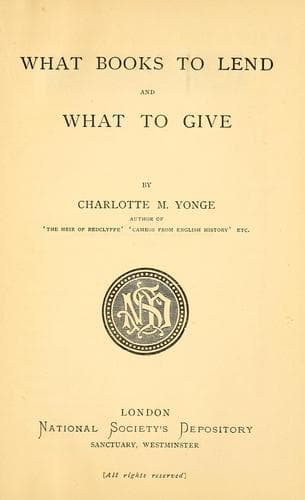
What books to lend and what to giveYonge, Charlotte M. (Charlotte Mary)
General
What books to lend and what to give
Yonge, Charlotte M. (Charlotte Mary)
Books and reading -- Great Britain; Children's literature -- Bibliography
Those who act as Sunday school teachers may, however, be led to study
books bearing on the subjects they have to teach, or to get up for
certificates, and thus may be brought to take an interest in religious
literature, which may deepen as they grow older.
There is always, too, a certain proportion who have a strong turn for
fact, and like to have solid truth before them. Of course all these can
read the same books as the elder men, and even more difficult ones, as
their education has gone farther; but they need more that is light, easy,
and inviting, and a lending-library or reading-room requires a supply
fitted for both.
It is a pity there is not more good biography suited for this purpose.
The popularity of Miss Marsh’s ‘Hedley Vicars’ showed what a book written
without too much detail and with general interest might be. Some of
Smiles’s biographies come near the mark, also some American ones, and
those shilling books of Cassell’s called ‘The World’s Workers,’ also some
published by Nelson and by Blackie.
Good books of travels, too, are increasing favourites; also such books
as ‘Her Majesty’s Mail,’ and ‘Engine-Driving Life.’ In fact, whatever
_wholesomely_ interests our own households may well be sent into the
club-room, provided it do not presuppose too much culture. Many of these
books may be bought second-hand at a cheap rate from the Libraries.
And there should be a good stock of standard fiction: Scott, Dickens,
Fenimore Cooper, are all to be had at almost any price, and would pretty
well supply in themselves the requirements of reading-room fiction.
The corresponding class of girls and young women are for the most
part indiscriminate devourers of fiction, and, like the women before
mentioned, need to have their appetite rightly directed. But there is
more hope of them than of their elders, and their ideal is capable of
being raised by high-minded tales, which may refine their notions. The
semi-religious novel or novelette is to them moralising put into action,
and the most likely way of reaching them.
We must not be too hasty to condemn their frivolous tastes. Whether in
business or in service, they are tired, the book is recreation, and
they cannot be expected to want to improve themselves when their brains
and bodies are alike weary. Still we can supply them with books that
will not give them false views of life, and that will foster enthusiasm
for courage and truth, make vulgarity disgusting, and show religion as
the only true spring of life. Through classes for Sunday teachers, and
Communicants’ or Bible classes, some spirit of religious study may be
infused.
Public-domain text, read in full here on John Shaqi.
Reviews
Reviews
No reviews yet
Be the first to share your thoughts on this work.
Join the Discussion
Join the discussion
Sign in to leave a comment or review.
Sign InorCreate an account