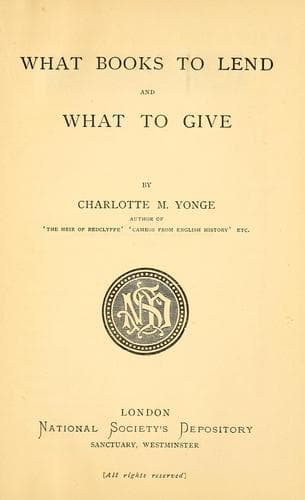
What books to lend and what to giveYonge, Charlotte M. (Charlotte Mary)
General
What books to lend and what to give
Yonge, Charlotte M. (Charlotte Mary)
Books and reading -- Great Britain; Children's literature -- Bibliography
As to secular self-improvement, the students will always be few and far
between, and the experience of most libraries is that there is little or
no demand for improving books. So much is _taught_ that there is little
inclination to learn. A reaction sometimes comes to men, but seldom to
women, whose home industries and occupations necessarily absorb them so
that their reading must be either devotional or recreative.
Thus there is very little call for improving books in the lending
library, in proportion to those meant for recreation; but I would urge
that they should be used for prizes. At present, the usual habit is
to choose gay outsides and pretty pictures, with little heed to the
contents, but it should be remembered that the lent book is ephemeral,
read in a week and passed on, while the prize remains, is exhibited to
relatives and friends, is read over and over, becomes a resource in
illness, and forms part of the possessions to be handed on to the next
generation. Therefore, after the infant period, the reward book should
generally be of some worthiness, either religious, improving, or at least
standard fiction. Weakness and poverty of thought should be avoided,
especially as these books may fall into the hands of clever, ungodly men,
and serve to excite their mockery. It should be remembered that the child
to whom the book is given will not always remain a child, and therefore
that it is better to let the new and cherished possession go beyond its
present level of taste or capacity.
The elder lad, whose schooldays are over, sometimes begins to waken to
intelligence, and to be ready to seek information, in some cases being
glad of really deep reading on scientific, political, or theological
subjects, and it is all-important to preoccupy his mind with sound views
before he meets with specious trash. Many indeed both of lads and men are
absorbed in actual practical life and never read at all, or nothing but
newspapers. Yet even these when laid low by illness will accept a book to
pass away the weary hours.
Nothing, of course, can equal the effect of personal influence, from
schoolmaster, clergyman, or lady, but each of these may find books, lent,
recommended, or read aloud, of great assistance.
Some books of advice deprecate reading aloud in Sunday schools. My own
experience, now of many years, is that it is of great assistance in
impressing the scholars, and gives great pleasure. I have been told of my
old pupils mentioning it as one of the enjoyments of their younger days;
and when a part of a story has been missed by absence, the connection is
eagerly supplied by the listeners who have been present. Moreover, those
books in the lending library are always most sought after which have been
read aloud, and sometimes elucidated, either at the Sunday school or at
the mothers’ meeting.
Public-domain text, read in full here on John Shaqi.
Reviews
Reviews
No reviews yet
Be the first to share your thoughts on this work.
Join the Discussion
Join the discussion
Sign in to leave a comment or review.
Sign InorCreate an account