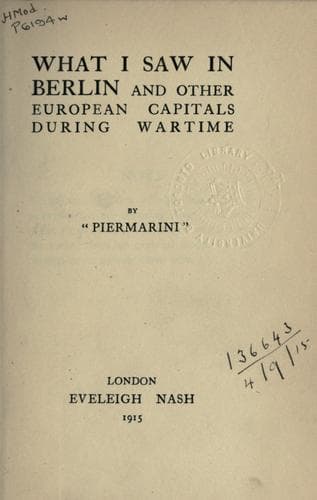
What I Saw in Berlin and Other European Capitals During Wartime — John Shaqi
What I Saw in Berlin and Other European Capitals During WartimePiermarini
History
What I Saw in Berlin and Other European Capitals During Wartime
Piermarini
Europe -- Description and travel; World War, 1914-1918 -- Personal narratives
Note: Images of the original pages are available through
Internet Archive. See
https://archive.org/details/whatisawinberlin00pieruoft
WHAT I SAW IN BERLIN
WHAT I SAW IN BERLIN AND OTHER
EUROPEAN CAPITALS DURING WARTIME
by
"PIERMARINI"
London
Eveleigh Nash
1915
NOTE
Several chapters of this book are reprinted from the _Evening News_
(London), to the Proprietors and Editor of which paper the author owes
his grateful thanks for the permission to include them here.
CONTENTS
PAGE
INTRODUCTORY 1
CHAPTER I
MY FIRST WAR-TIME JOURNEY TO BERLIN 11
CHAPTER II
POTSDAM AND HAMBURG 55
CHAPTER III
CONSTANTINOPLE 75
CHAPTER IV
BULGARIA AND GREECE 121
CHAPTER V
MY SECOND WAR-TIME VISIT TO BERLIN 142
CHAPTER VI
VIENNA 184
CHAPTER VII
SWITZERLAND 196
CHAPTER VIII
ITALY 205
CHAPTER IX
FRANCE 221
CHAPTER X
HOLLAND 240
CHAPTER XI
ANTWERP--THE DEAD CITIES OF BRABANT 259
CHAPTER XII
BRUSSELS, TOURNAI, AND THE GERMAN FRONT 284
WHAT I SAW IN BERLIN
AND OTHER EUROPEAN CAPITALS
INTRODUCTORY
The golden days of the war correspondents have long since passed away;
the unlimited freedom allowed to newspaper correspondents during the
1870 war, the fact that Germany could know every move, every change
of front, even the exact figures of the different contingents of
troops, by the simple method of getting the Paris papers, and the many
instances during both the Spanish-American and Russo-Japanese Wars, in
which supposed war correspondents turned out to be dangerous spies,
have made the commanders of the fighting armies extremely careful; and
the war correspondent is kept so far from the firing-line that even if
he manages to get near to the front, he is allowed to see practically
nothing, and his report is based only on what he can get out of
soldiers back from the line of fire.
Moreover, the enormously wide front of the modern battlefield makes it
absolutely impossible for the war correspondent to gain anything like
an exact idea of what is going on. His work is essentially a work of
analysis, analysis of the section in which he moves, but the synthesis
of the whole movement is bound to escape his observation.
Public-domain text, read in full here on John Shaqi.
Reviews
Reviews
No reviews yet
Be the first to share your thoughts on this work.
Join the Discussion
Join the discussion
Sign in to leave a comment or review.
Sign InorCreate an account