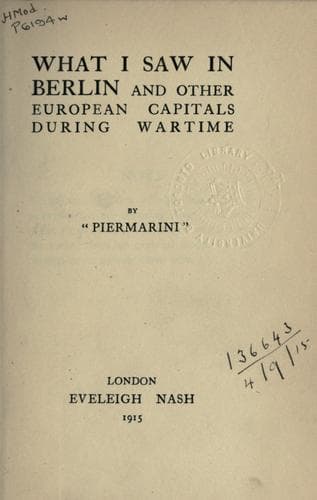
What I Saw in Berlin and Other European Capitals During WartimePiermarini
History
What I Saw in Berlin and Other European Capitals During Wartime
Piermarini
Europe -- Description and travel; World War, 1914-1918 -- Personal narratives
I know some instances of such cases which are very common in Brussels.
The father of one lady, who received such a visit from an officer
accompanied by two soldiers at three o'clock in the morning, is a very
highly placed Belgian official. He protested at the Kommandantur, but
the answer he had was that the officer was perfectly right in so doing.
All German attempts to make friends with the population have failed.
I know of officers, once personal friends of Belgian families, who have
tried in vain to revive the old acquaintance.
Of course, there are a few families who have received the German
officers, and these are consequently in favour. In a family of parvenus
which hopes to take a better place in Brussels society if the German
occupation continues, the Kaiser's birthday was celebrated with a
dinner for officers, followed by a dance, permission being gladly
granted by the Kommandantur.
But Brussels society, needless to say, has completely ostracised these
people. Even the Germans at heart despise them.
"We go to the house," said the officer who told me of the Kaiser's
birthday-party, "because we have nowhere else to go, but we know
perfectly well they only do it because they think it will improve their
social position. They are not exactly the kind of people I shall like
to shake hands with when the war is over."
* * *
There is one part of Brussels which has never been properly
occupied--the part which lies on the other side of the port and of
the Bassin Vergote, the so-called Marolle, the East End of the Belgian
capital. During the first month of the occupation the Kommandantur
tried to establish a proper military police service there, as in the
other quarters of the town; but each night several of the men in the
patrol disappeared, and often a full patrol would meet a similar end.
The Brussels apaches have always been armed with long thin knives, and
they took no notice of the order to give up all arms to the police.
As the high powers of Berlin did not want a wholesale imprisonment
or the destruction of the entire quarter, which would have been the
only remedy, the Kommandantur has compromised. The Marolle is occupied
during the day, and free during the night. Patrols go through it in
daylight, but when evening comes they cross the water and retire into
the old "Luna Park," now converted into a large prison and barracks.
The high and smartest part of the town is completely given up to
the Germans. The Palais de la Nation, and the Palais du Roe, the
beautiful Palais des Beaux Arts, and the colossal Palais de Justice,
are the headquarters of the German Government of Belgium. New German
inscriptions tell the new uses of the palaces, and, what is rather
important, no reference is made to a temporary government of Belgium;
the inscriptions simply say, "German Empire--Government of the Belgian
Provinces."
Public-domain text, read in full here on John Shaqi.
Reviews
Reviews
No reviews yet
Be the first to share your thoughts on this work.
Elsewhere in the archive
Join the Discussion
Join the discussion
Sign in to leave a comment or review.
Sign InorCreate an account