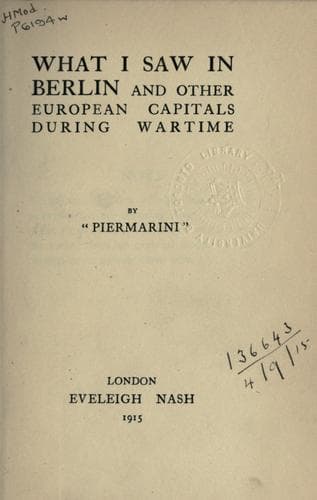
What I Saw in Berlin and Other European Capitals During WartimePiermarini
History
What I Saw in Berlin and Other European Capitals During Wartime
Piermarini
Europe -- Description and travel; World War, 1914-1918 -- Personal narratives
Near the Palais de Justice, which occupies a dominating position on a
hill almost in the centre of the town, twenty large siege guns have
been placed, and near them artillery officers and men connected with
the Kommandantur by a camp telephone are ready to pour on the quiet
town death and destruction should the necessity of subduing riots arise.
The most important monuments, art galleries, and churches are said to
be mined, and the German authorities do not deny the rumour.
On the boulevards and down the beautiful Avenue Louise, at the
Cinquantenaire, and at the Bois de la Cambre, generally full of smart
people, of horse-riders, and of carriages and motor-cars, there are now
only old Landsturm soldiers drilling and very young officers riding,
often accompanied by ladies, who, even in this the smartest of sports,
cannot get rid of a certain Teutonic awkwardness.
The German nation has always been celebrated for her immoderate liking
for issuing long and complicated notices, warnings which are possible
only in Germany because in no other country would people take the
trouble to read them.
In Belgium this mania has reached its highest possible point. On
the ruins of the dead cities and on the trees in the open country,
on the gates of the gardens, and on the milestones of the country
roads, everywhere where there is space enough, the German Government
has posted notices, printed in three languages--German, Flemish,
and French--headed with the German eagle and signed by the
Governor-General.
Brussels is covered with a sort of incrustation of old and new official
notices; notices about closing time for shops and cafés, about grouping
in the streets, about meetings in clubs, about drinking spirits, about
singing forbidden songs, about buying or selling forbidden stuff,
about keeping arms, photographic cameras, or maps, about detaining
gold instead of giving it up to the banks, about giving hospitality to
refugees or foreigners, about everything on earth.
The list of things "verboten" would probably take more than a full
page, but what is most insisted upon and is the subject of five or six
different notices is the introduction of foreign papers into Belgium
and the sale, or possession, of newspapers of any kind besides the ones
sold openly in Belgium, a full list of which is given.
These are: a few Belgian papers, naturally issued under the vigilant
eye of the most particular of censors; some German papers, not all of
them, as many are considered much too advanced to be allowed into the
hands of Belgian people; and a Rotterdam sheet, which has the privilege
of being the only foreign journal allowed into Belgium, a privilege
more apparent than real, as the paper is notoriously in German hands.
Public-domain text, read in full here on John Shaqi.
Reviews
Reviews
No reviews yet
Be the first to share your thoughts on this work.
Elsewhere in the archive
Join the Discussion
Join the discussion
Sign in to leave a comment or review.
Sign InorCreate an account