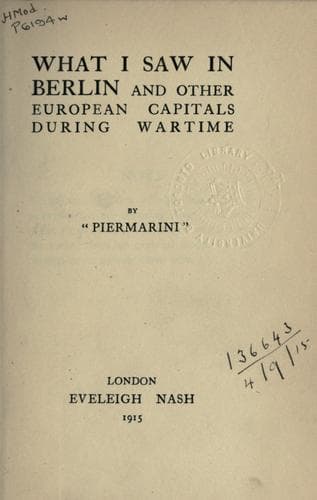
What I Saw in Berlin and Other European Capitals During WartimePiermarini
History
What I Saw in Berlin and Other European Capitals During Wartime
Piermarini
Europe -- Description and travel; World War, 1914-1918 -- Personal narratives
It will easily be understood how the Belgian population feels more than
anything else this complete lack of real news, and how eager they are
for the information which is brought in by the few refugees who succeed
in going back or by the few foreign papers they manage to smuggle in at
great risk and great expense.
The other papers, the ones which are allowed, print the most fantastic
news. I was in Brussels the day of the Zeppelin raid on the British
coast; the aircraft, according to the news for Belgian consumption,
reached London and dropped bombs all over the metropolis. Every day
or two a great victory is claimed on either front, and the official
reports of foreign countries published in the papers are only mutilated
and distorted reductions of the real ones.
To be found in possession of forbidden papers is extremely dangerous.
A gentleman belonging to one of the best Brussels families was given
two months' concentration camp for translating articles from _The
Times_, and one of his office clerks, who got hold of the translations
and typed them and sold them, had to serve a six months' sentence. In
spite of all this, I managed to get a copy of _The Times_ nearly every
day, paying for it two francs fifty, which is certainly a fair price,
but not too high considering the difficulty of introducing it into
Belgium, and that it was generally only two days old.
Up to about two months ago people would gladly pay twenty-five francs
for a copy of the paper; refugees and Dutch people used to take it in
at great risk, but now with an admirable sense of adaptability, the
German soldiers, Custom House officers, and railway employees have
organised this delicate service.
They get _The Times_ or the _Figaro_ for twopence at the Dutch frontier
and sell it again to some agent in Brussels or straight to the public
at a nice profit. One must, of course, be extremely careful in buying
papers offered on sale by such people, as this is one of the favourite
victim-hunting systems of the numberless spies of the Kommandantur.
In a difficult moment like the present one the Belgian Press, or the
part of it which stuck to its place and kept independent from German
influence, has assumed a very dignified attitude.
_La Belgique_, _Le Bruxellois_, _La Patrie_, etc., publish the
different _communiqués_, French, German, English, and Russian, but
never forget to put, as an undertitle, "As transmitted to us by the
Censor." Very often the papers come out with large blank spaces, the
whole or part of an article having been censored.
At a famous restaurant near the "Halles," which is the meeting-place of
journalistic and literary folk in Brussels, I met an old friend, now
editor of a large Brussels paper.
He thought it was his duty not to leave the town and to try to give
the Belgian public as truthful news as possible about the war, but he
admitted the task he had assumed was almost impossible.
Public-domain text, read in full here on John Shaqi.
Reviews
Reviews
No reviews yet
Be the first to share your thoughts on this work.
Elsewhere in the archive
Join the Discussion
Join the discussion
Sign in to leave a comment or review.
Sign InorCreate an account