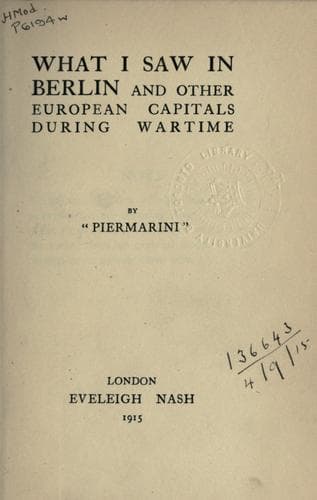
What I Saw in Berlin and Other European Capitals During WartimePiermarini
History
What I Saw in Berlin and Other European Capitals During Wartime
Piermarini
Europe -- Description and travel; World War, 1914-1918 -- Personal narratives
All communications with foreign countries have been interrupted, and
the papers must depend completely on the censor for news. The few items
of correspondence which he could manage to get through from England
and France were not allowed to be printed, and quotations from foreign
papers are strictly forbidden.
The German Government tried often with his paper, and with all the
others of a certain importance, to convert them into Germanophile
papers, offering large sums of money and great advantages of every
kind. Such offers were naturally refused, and now the Germans have
founded a new paper, the title of which sounds very Belgian, while the
editor and staff have been carefully selected amongst people who are,
at least as far as their name goes, thoroughly Belgian.
This is now the leading organ of the Germanophil movement.
"Many Belgians in London?" asked my friend, after a pause.
"Too many," I could not help answering.
"Oh, we know, we know. Twenty per cent. are perhaps _real_ refugees,
and the others are slackers, or people who fancy that, after all, a
season in London is the best way of dealing with the crisis.
"I wonder if the young men who left Belgium on the pretext of
enlisting, and who are now 'acting the referee' in London, know that we
consider them a disgrace to our country?
"If a man cannot fight with our King on the last bit of Belgian soil,
his duty is to stick to his town, to his village, or to his country
house. Especially if he is a man of wealth, and most Belgians now in
London are fairly well off, there is plenty for him to do here."
The very same thing was repeated to me by hundreds of people while I
was in Belgium.
A lady who ten or twelve years since has spent every winter in her
beautiful villa in Bordighera, and who, for the first time, did not
this year leave Brussels, where she is managing an emergency hospital
for children, said to me: "When you go back to England, please tell
the English that we Belgians do not want to be judged by those of us
who are now in London enjoying themselves in theatres and night clubs.
What they spend in an evening would be sufficient to keep one of our
starving families for a week. We know, from some refugees who have
come back, how even a number of young men are enjoying in England an
idle life and a free and large hospitality. Such people should not be
surprised if, when the war is over and they are back in Belgium, they
are considered as outcasts. We shall not have any room for them in our
society. They have deserted Belgium when she was most in need of them;
they have made us look like cowards in the eyes of the country which
has been helping us most gallantly, and they will not be surprised, I
think, to be ostracised by the rest of their countryfolk.
Public-domain text, read in full here on John Shaqi.
Reviews
Reviews
No reviews yet
Be the first to share your thoughts on this work.
Elsewhere in the archive
Join the Discussion
Join the discussion
Sign in to leave a comment or review.
Sign InorCreate an account