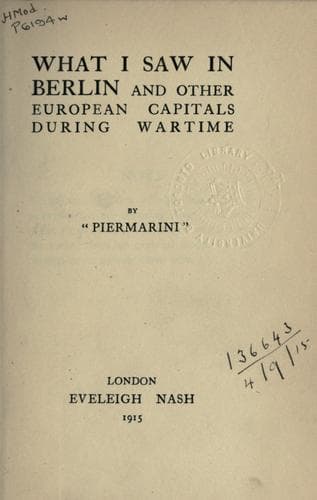
What I Saw in Berlin and Other European Capitals During WartimePiermarini
History
What I Saw in Berlin and Other European Capitals During Wartime
Piermarini
Europe -- Description and travel; World War, 1914-1918 -- Personal narratives
For my trip to Potsdam I had a bright, sunny morning. Potsdam, the
favourite residence of the Kaiser, and one of the most intensely
Prussian towns of Prussia, owing to the enormous number of barracks,
military buildings, and academies she has in proportion to her size,
attracted me for two reasons.
First, I knew any amount of military drill was daily going on in the
large drill grounds, and that Potsdam, the cradle of the Prussian Army,
would be specially interesting to see in war time.
Secondly, the only concentration camp in the immediate vicinity of
Berlin in which British prisoners are kept is Doberitz, quite close to
Potsdam.
Potsdam gave me straight away the impression of being absolutely full
of soldiers. The regular garrison has gone to the front, of course, but
the first classes of the Landsturm, just called to arms, are drilling
day and night in the grounds of the artillery barracks.
Some of the new guns (for the Russian frontier, I learn) are being
tested, and the military academy has been converted into a huge
hospital. The ugly, pretentious little town, full of copies of
old Italian and French buildings, seemed to be populated by an
extraordinary number of people in mourning, probably owing to the
fact that Potsdam being a garrison town, quite a number of officers'
families reside there.
The entrance to the castle of Sans Souci, to the New Palace, and to the
Marble Palace is _verboten_. I asked the reason of this, and I was told
that the buildings are now being devoted to military purposes.
I was losing all hope of being able to see something of interest when
the noise of a powerful engine made me look over my head. A gigantic
Zeppelin was performing different evolutions, dropping and rising again
hundreds of feet, changing the direction, and pointing a massive nose
now to the earth, now to the sky.
I could see from the stability planes and from the shape of the tail
that it was one of the very latest models; also a sort of silvery
paint, probably the aluminium varnish which has been in use for years
in the Italian aerial fleet, had been adopted instead of the old grey
or copal varnish. I easily managed to find out that this was the first
test of a new machine, that two airships exactly alike were being
equipped in the flying grounds on the west side of the town, and that
old Count Zeppelin himself was looking after the operations.
From morning to sunset there was an enormous activity in the whole of
the aerial park. Over a hundred aeroplanes of the Taube type were under
construction, and I was told that in every one of the German towns
which possesses aeroplane works, flying machines are being built in
large numbers. Apparently the idea is not only to supply machines in
place of those lost or damaged on the frontiers, but to have a very
large number of aeroplanes ready for next spring.
Public-domain text, read in full here on John Shaqi.
Reviews
Reviews
No reviews yet
Be the first to share your thoughts on this work.
Join the Discussion
Join the discussion
Sign in to leave a comment or review.
Sign InorCreate an account