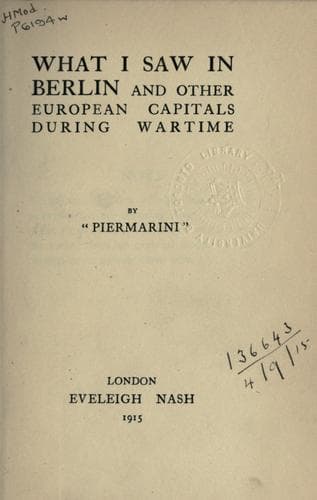
What I Saw in Berlin and Other European Capitals During WartimePiermarini
History
What I Saw in Berlin and Other European Capitals During Wartime
Piermarini
Europe -- Description and travel; World War, 1914-1918 -- Personal narratives
The beautiful Florentine palace, the residence of the British
Ambassador, had a few windows smashed, and two large hotels owned by
French societies were also damaged.
This Jingo crowd was mostly composed of people wearing the fez, but
of rather Western appearance. Some of them, fair haired, and of true
Teutonic bearing, did not leave any doubts about their nationality,
some bore the mark of their Jewish descent, some belonged to the
international mob of all big seaports. I don't know if amongst the
crowd there was a single real Turk.
As I write, in the large square outside the Arsenal, military
exercises under the command of Turkish and German officers are going
on. The Germans attached to the Turkish army or to the Embassy in
Constantinople have organised all the young Germans into a regular
troop. Now every one of them is acting as an instructor, and probably
before long they will have a uniform and an official status in the
Turco-German army.
During the last two weeks trains loaded with arms, ammunition of all
kinds, Red Cross requisites, and even guns have been arriving from the
north. An enormous quantity of sea mines has been sent down--evident
sign that the Germans intend to follow in the Dardanelles the same
tactics of naval war they are following in the North Sea.
A large part of the Fleet, I really don't know if I have to call it the
Turkish fleet or the Allied fleet, or perhaps the German fleet, has
come back into the Bosphorus. The names of the vessels are, of course,
quite Turkish. The _Goeben_ was rechristened _Sultan Selim_; the
_Breslau_ got instead the new name of _Medilla_, which means _Mitilen_,
in Turkish.
The bridge on the Golden Horn is open, and yesterday the _Goeben_ went
right across the long bay and dropped anchor outside the Arsenal.
Then on the ship began a sort of feverish work. A number of large
flat-bottomed boats were sent out from the Arsenal loaded with workmen,
who proceeded to do some mysterious repairs on board. It was possible
to hear the continuous hammering, but the distance did not allow me to
see what kind of work was going on.
Certainly no great damage had been done to the ship because, while the
repairs were going on, a large quantity of ammunition and numerous
cases which looked as though they contained foodstuffs were lifted on
board with the help of two big cranes.
In the afternoon I made the acquaintance of a German officer who had
been on board the _Goeben_ during the last three years. He told me that
the ship had not suffered any serious damage; something went wrong with
the helm, but it would be all right in the evening.
My new friend seemed most proud of the exploits of his ship during the
last month, and when I flattered his vanity by telling him that the
_Goeben_ and _Breslau_ had been the talk of all Europe for many weeks,
he was so pleased that he willingly told me all that had happened on
board since the outbreak of war.
Public-domain text, read in full here on John Shaqi.
Reviews
Reviews
No reviews yet
Be the first to share your thoughts on this work.
Join the Discussion
Join the discussion
Sign in to leave a comment or review.
Sign InorCreate an account