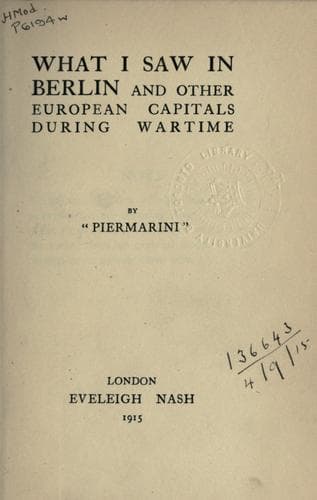
What I Saw in Berlin and Other European Capitals During WartimePiermarini
History
What I Saw in Berlin and Other European Capitals During Wartime
Piermarini
Europe -- Description and travel; World War, 1914-1918 -- Personal narratives
Everybody bows deeply, but the Sultan does not show himself. His
carriage drives between the double ranks of troops once only, and then
disappears under the large arch of the Artillery Barracks.
The new Sultan is said to detest appearing in public. He has
abolished, for this reason, all the traditional ceremonies, all the
luxurious habits of the old Court, and lives quietly like a private
citizen in the Dolma-Bagtche-Serai. The wonderful palace of Abdul Hamid
on the Asiatic side of the Bosphorus is much too imposing for his
simple taste. Mohamed the Fifth is neither loved nor hated; the Turkish
population simply ignores his existence.
After the departure of the Sultan the troops get on with their drills.
There are about 10,000 infantrymen, fifty field guns, and not more than
a dozen pieces of Horse Artillery of a fairly old model. The field guns
are the famous ones bought from Krupp at the time of the Balkan War,
which arrived at Constantinople after the peace was concluded.
At the back of the Artillery Barracks is a large Turkish cemetery in
which numerous tents have been erected to shelter the Asiatic troops
coming through Constantinople. A large and curious crowd watches the
dark-skinned, oily-haired soldiers cooking their own food or making,
with a sort of religious concentration, a drop of coffee in a copper
saucepan not larger than a small egg.
Here is the German Embassy, where there is a great movement of Turkish
and German officers, and where a long line of motor-cars waits outside
the door. From the balcony over the main entrance hangs a picture of
the Kaiser and a large German flag. To the left side of the Embassy is
a powerful wireless station.
This may be considered as the real War Office in Constantinople at the
present moment. Near the door, on a large blackboard, is exposed the
latest news from the theatres of war.
Stringent police regulations allow nobody to pass near the wireless
station.
I am just passing on, when a coach, similar to that one in which the
Sultan reviewed his troops, stops in front of the Embassy. A little man
in fez and morning coat alights. At the first glance I recognise him
as Enver Pasha. This was the only glance of Turkey's great man that I
could get during my stay in Constantinople.
I walked down the great road of Pera, generally full of tourists,
motor-cars, and carriages, where smart European society in
Constantinople meets.
Since last Sunday half of the few shops and hotels which were still
open have closed. The war has completely spoiled the most flourishing
of Pera's industries.
A large building on the left-hand side, over which the Red Cross flag
waves, attracts my attention. It is the German school turned into a
hospital, and placed under the direction of Princess Najieh, Enver
Pasha's wife. Only a few years ago it would have been impossible to
imagine a Turkish woman doing useful work, still less nursing soldiers;
but now old Turkey is dying.
Public-domain text, read in full here on John Shaqi.
Reviews
Reviews
No reviews yet
Be the first to share your thoughts on this work.
Join the Discussion
Join the discussion
Sign in to leave a comment or review.
Sign InorCreate an account