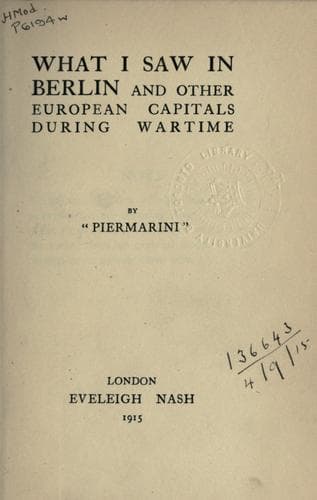
What I Saw in Berlin and Other European Capitals During Wartime — John Shaqi
What I Saw in Berlin and Other European Capitals During WartimePiermarini
History
What I Saw in Berlin and Other European Capitals During Wartime
Piermarini
Europe -- Description and travel; World War, 1914-1918 -- Personal narratives
The German ladies in Constantinople have organised another large
emergency hospital in the Skating Rink a few hundred yards lower down
the same street. Over a hundred wounded have already arrived from the
Russian frontier, I am told. All the Red Cross materials have been
ready here for a long time, and doctors and nurses came from Berlin
three or four days before the declaration of war. A curious coincidence
that they should know exactly when their services would be required!
Down the great route of Pera, near the Tunnel, the crowd is getting
thicker, a crowd, as usual, composed almost exclusively of German or
Germanophile elements. Here is the German Club, the famous centre of
the Pan-German movement in Constantinople.
I easily mix with some of the impromptu politicians; all the Germans in
Constantinople who are too old to bear arms try to do what they can for
the Fatherland by carrying out a sort of advertising campaign. They can
fight no more, but they can talk.
In a few minutes I learn that the Russians are "no good"; that the
British Fleet was "all bluff"; that the French soldiers are "running
away like rabbits," and other interesting revelations. But my fat
little man, who is, I learn, the manager of the German Bazaar near
Andria's Passage, begins really to attract my attention when he
describes what will happen on the day of final German victory.
"Austria will probably be added to the German Empire, together with
Hungary, Russian Poland, Bosnia and Herzegovina. Each would have the
present system of the German confederation, by which every State has
a certain autonomy but only one Emperor, one administration, and one
army. It will be the largest Empire ever seen since Napoleon, but we
are certain, with our organising capabilities, to be able to make it
last a long time.
"Take Turkey! She is certainly the most practical nation in Europe; she
has seen that it was no use trying to resist us, and she has accepted
our quiet superiority. We are the brains, and she is the hands, and you
can be certain that it will be all the better for her to have taken
this step in time."
"And what will happen afterwards to Constantinople?"
"Oh! we shall always be friends with the Turks. They know our
superiority, and they respect us. It is really of no importance for us
to have Constantinople as long as we know that Russia will never be
able to have it."
While my companion is telling me the modest German aspirations and the
future plans for the wholesale Germanisation of the world, we have
walked slowly across the Perchembe-Bazaar (Thursday's market). It is
market day, but the business is next to nothing. Most of the merchants
have not come at all, others are sitting philosophically amongst
mountains of carpets, embroideries, and potteries, waiting for the
customer who does not come.
Public-domain text, read in full here on John Shaqi.
Reviews
Reviews
No reviews yet
Be the first to share your thoughts on this work.
Join the Discussion
Join the discussion
Sign in to leave a comment or review.
Sign InorCreate an account