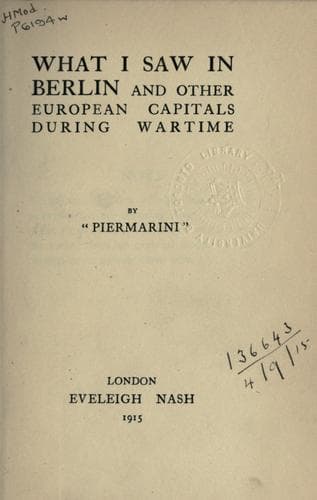
What I Saw in Berlin and Other European Capitals During WartimePiermarini
History
What I Saw in Berlin and Other European Capitals During Wartime
Piermarini
Europe -- Description and travel; World War, 1914-1918 -- Personal narratives
After waiting a few hours in a dirty inn full of soldiers, of
pipe-smoke, and of the onion-like smell of Turkish cooking, I managed
to get a train to Dedeagatch. There another unpleasant surprise awaited
me. Bulgaria had two days ago closed her ports and no boat was allowed
to sail.
Dedeagatch, the curious little town in which it seems impossible to
meet two people of the same nationality, so mixed are the races, the
costumes, the languages, does not show any signs of its recent change
of proprietorship. Dirt and dogs and rags are everywhere, as in a true
Turkish town.
I remember an old journalist of wide Balkan experience and of great
wit, Vico Mantegazza, telling me two years ago: "You ask a Bulgarian
for his political ideas or the designs of his country's diplomacy, then
reverse his answer, and you will be just as near the truth as you will
ever get!"
As a matter of fact, every Bulgarian I have had occasion to talk to,
lately, has told me a different tale. To some the enemy is Greece;
to others Serbia. At a few minutes' interval I was told, first, by
an officer, that Bulgaria wanted another fight with Turkey, "her
traditional enemy"--and then that Bulgaria's relations with Turkey had
been excellent since the last war, and would probably continue so for a
long time.
The impression I received here was that the Austro-German influence is
very strong; Bulgaria is ruled by a German, the German language is
spoken and understood everywhere, and business life as well as private
life is strictly connected with Germany. I do not know if the charge
of ingratitude generally made against Bulgaria is true, but it seems
that the country has forgotten the times of the dreadful, century-long
Turkish domination and the help Russia always gave to Bulgaria, who
owes to the great Slav nation both her birth as an independent State
and her existence after the last war.
The immoderate ambitions of the Bulgarian Government, ambitions of
increasing her territory and of becoming _the_ great nation of the
Balkans, has made her forget all this. It is certain that no mystery
is made in Bulgaria of her bitter feelings against Russia, feelings
reciprocated by Petrograd papers, which call the Bulgarians "the Balkan
Germans."
The personal influence of King Ferdinand has been very strong; he has
Germanised his capital and most of the important towns of his nation,
and has tried to attenuate as much as possible the natural intercourse
of Bulgaria with the other Slav countries.
The unnatural relations between Bulgaria and Serbia are a continuous
danger to the Entente. Bulgaria is certainly going to keep neutral for
some time, but supposing Serbia should one day suffer reverses on the
Austrian frontier, who could be sure of Bulgaria's attitude?
The infatuation for the German-Austrian power is such that one often
hears sentences like this: "Germany and Austria united cannot be beaten
by any nation on earth."
Public-domain text, read in full here on John Shaqi.
Reviews
Reviews
No reviews yet
Be the first to share your thoughts on this work.
Join the Discussion
Join the discussion
Sign in to leave a comment or review.
Sign InorCreate an account