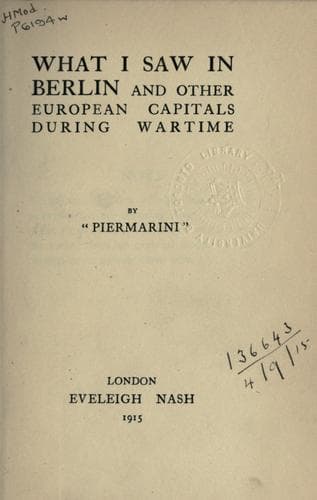
What I Saw in Berlin and Other European Capitals During Wartime — John Shaqi
What I Saw in Berlin and Other European Capitals During WartimePiermarini
History
What I Saw in Berlin and Other European Capitals During Wartime
Piermarini
Europe -- Description and travel; World War, 1914-1918 -- Personal narratives
The Turkish commerce has such deep roots that it did not stop even
three years ago, when the Allied troops were a few miles from the
town. Now it is completely paralysed.
Perhaps even the Turks begin to feel that the crisis is, this time,
bigger than ever before.
Always chatting, we reach St. Peter's Church, and my attention is
attracted by a white marble tablet, on which I read: "André Chénier
naquit dans cette maison le 30 Octobre, 1762." Under it, on the brown
painted wall, one of his verses is written with chalk by a hand
evidently used to German characters:--
"Ces Anglais,
Nation tout à vendre à qui peut la payer."
(England, the nation that always sells herself to the best bidder.)
I wonder who is the learned German who knows Chénier's work well enough
to get out of it just the line which, in his opinion, suits the present
situation?
I show the stone tablet to my companion, and he explains, very proud to
show me that he knows all about the poet of Charlotte. "Oh, yes, he
was a great Frenchman, and, of course, they have had him hanged."
I don't insist on the fact that the poet-encyclopædist was not hanged,
but beheaded, and he goes on, "France could be really a great nation.
She has genius, she has initiative, but she does not know how to
organise her moral and material means, so as to get the maximum effort
out of them."
I feel that he is going to describe to me what a wonderful nation
France would be under a German Government, so I leave him to his dreams
of megalomania. Let us hope he will wake up soon!
CHAPTER IV
BULGARIA AND GREECE
Thanks to the kindness of a member of the Chilian Embassy, I managed to
get out of Constantinople in his car without having to wait my turn.
The booking-office at the Adrianople station was besieged by a crowd
impatient to leave the town, and a sleepy-looking clerk wrote down the
names, received the money for the tickets, and told the unfortunate
travellers to call in a couple of days, when he would perhaps be able
to let them know by which train they might leave. Some took the thing
philosophically, some tried to protest; but nobody, unless of Turkish
or German nationality, was allowed to travel by military trains. No
cars or vehicles of any kind were allowed on the road unless carrying
officials.
We went across the theatre of Turkey's last war. At Tchataldja the
almost tropical vegetation has not yet returned to efface, or even to
disguise, the trenches, which were the last defence of Constantinople.
"Here Turkey had her last close shave," laughingly said my driver.
"The next one will be more severe, I am afraid; for me, I should not
be surprised to see the Russians, or the English, or even both, here
before next summer." At Pavlo-Keni I left my courteous guide.
Public-domain text, read in full here on John Shaqi.
Reviews
Reviews
No reviews yet
Be the first to share your thoughts on this work.
Join the Discussion
Join the discussion
Sign in to leave a comment or review.
Sign InorCreate an account