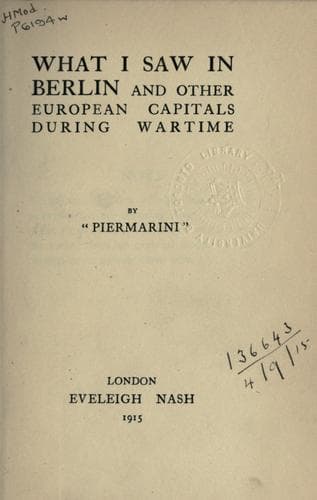
What I Saw in Berlin and Other European Capitals During WartimePiermarini
History
What I Saw in Berlin and Other European Capitals During Wartime
Piermarini
Europe -- Description and travel; World War, 1914-1918 -- Personal narratives
This has happened to me, as I will relate later on, and also to most
American and Dutch subjects who get into Belgium at the present moment.
Some of them, for the simple fact that they are journalists, are taken
to Germany and interned there, and when the Embassies of the different
countries protest and claim their subjects, the Government of Berlin
answers that the captured journalists are not considered as prisoners,
but are only detained for a certain time--that is to say, for as long
as the news they have gathered remains important if made public.
Another variety of the so-called German Secret Service is the
agent-provocateur, who generally speaks perfect French and Flemish,
and gets a fixed sum for every arrest effected by the police on his
initiative.
In Antwerp I saw one of these spies approach an old gentleman who had
a Belgian rosette in his buttonhole. He was on a tramcar platform, and
the spy said to him, "Very bitter weather for our poor little soldiers
at the front, isn't it, sir?" The old gentleman evidently knew the
identity of his companion, for he simply stared at the rascal and
turned his face the other way.
The favourite ground of action of this army of spies is the railway
carriage. There acquaintances are easily and quickly made. I very often
saw people taken away at the station by two soldiers, while the hero
of this beautiful deed was following at a short distance with his face
wreathed in the happiest of smiles.
To travel in Belgium now is a complicated task; railways are completely
taken over by the German War Office, and only Germans are employed.
Not even the old porters are allowed in the stations. No tickets are
given without a special pass from the Kommandantur of the town, saying
where the applicant wishes to go, for how long, and for what reason.
Then you pay for your ticket, provided you make yourself understood by
the German employees, and you have the exact amount in marks and not
in Belgian money. There are only third-class carriages at first-class
fares--für Zivilpersonen--all the other first and second class
carriages are marked Nur für Heeresangehorige--those who don't pay
evidently.
Before arriving on the platform you are searched by very rude soldiers
wearing a large crescent-shaped brass plate with the word "polizei"
suspended to their necks by a chain, like a metal label on a brandy
bottle.
Public-domain text, read in full here on John Shaqi.
Reviews
Reviews
No reviews yet
Be the first to share your thoughts on this work.
Elsewhere in the archive
Join the Discussion
Join the discussion
Sign in to leave a comment or review.
Sign InorCreate an account