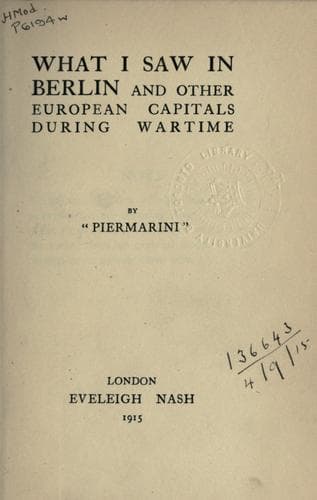
What I Saw in Berlin and Other European Capitals During WartimePiermarini
History
What I Saw in Berlin and Other European Capitals During Wartime
Piermarini
Europe -- Description and travel; World War, 1914-1918 -- Personal narratives
After this you carry your own luggage to the train, which is
thoughtfully kept waiting a quarter of a mile outside the station, in
rain or snow, and sit down in a freezing carriage without any light or
heating, but possibly with one or more windows smashed. Half an hour
or so after the fixed time the train begins to move; a little notice,
in German naturally, tells you not to put your head outside the window
while crossing a bridge because sentries will shoot at you, and another
notice says that, owing to the crisis, you may be asked to step out of
the carriage at any moment and without any right to protest, even if
you happen to have the pluck to do so.
And ultimately, after hours waiting in intermediate railway stations,
after changing trains two or three times on a ten miles' fare, you
sometimes arrive; you and your luggage are searched once again, and
then you are let out.
I feel sure most of those gentlemen got their iron crosses for much
less than this Odyssey.
* * *
It was five o'clock in the afternoon when I walked out of Louvain
station on to a muddy piece of uneven ground surrounded by ruins which
were once the station square. It was a grey day, and a few stray flakes
of snow were blown by the icy whirlwind in all directions. The weather
was perfectly consonant with the general aspect of the town.
Right and left I could discover nothing but ruins; it was hard to
tell which was the road and which the site of former buildings.
Enormous masses of calcinated bricks and stones are all that remain
of the houses which have collapsed; as for the others which are still
standing, their appearance is still more tragic. All the inside part,
the ceilings, the staircases, the roofs, have been burned away, and the
outer wall, all out of perpendicular, still shows the pots of flowers,
the iron bars, and the metallic parts of the shutters which were burned
away.
Entire rows of houses protrude on the street as if they are going to
collapse at any minute; others lean backwards just as if they were
frightened; others are all leaning on the right or the left side as if
a terrible wind had forced them into that unnatural position.
Here at another spot the walls of two houses touch each other at the
top, forming a sort of pointed arch. The steeple of a little church
leans far more than the famous Pisa Tower.
Public-domain text, read in full here on John Shaqi.
Reviews
Reviews
No reviews yet
Be the first to share your thoughts on this work.
Elsewhere in the archive
Join the Discussion
Join the discussion
Sign in to leave a comment or review.
Sign InorCreate an account