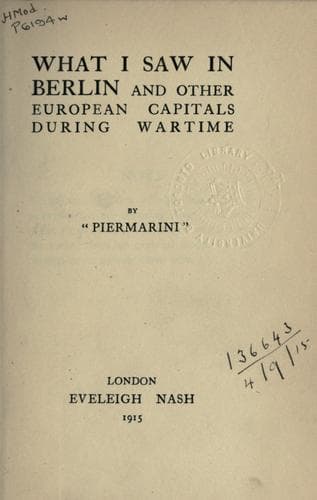
What I Saw in Berlin and Other European Capitals During WartimePiermarini
History
What I Saw in Berlin and Other European Capitals During Wartime
Piermarini
Europe -- Description and travel; World War, 1914-1918 -- Personal narratives
From every window there hangs a curious sort of transparent stalactite,
which at first sight looks like an icicle, and is formed by the
window glass melted in the dreadful heat. A three-floor house has
collapsed completely except for the wall facing the street, and at
one of the second-floor windows a bird-cage, suspended by a chain, is
still hanging, and the blizzard rattles it continuously to and fro.
For the fire has got a sort of sinister humour of its own. Here it
has destroyed completely the powerful masonry of a fifteenth-century
house whose walls were four feet thick, and next door it has blackened
without burning a fragile-looking cottage, and even left a white and
red check curtain hanging from the window. Further down, a butcher's
shop has completely disappeared, but a large metallic sign with an
enormous bull painted on it is still at its place, sustained, a miracle
of balance, by the frame of the burned awning.
I walk down the Rue de la Station to the Grand' Place. Here was the
fine theatre in Italian renaissance; now only the four pillars of the
front mark the place where it was standing. Farther down, near the
gigantic ruins of the University and the Library, is the once-famous
Cathedral of St. Peter.
Up to a few months ago this building was one of the most beautiful
examples of the Flemish florid-Gothic. All lovers of old things
remember its windows, made more elegant than those of any other
Gothic cathedral by a sort of carved balcony, its steep roof, its
solid-looking, severe front without the traditional portals. Now all
this has disappeared. The roof has collapsed. The wonderfully painted
stained windows are no more. The carvings have been reduced to
shapeless calcinated stones, and the bricks underneath, re-baked by
the flames, show themselves as red as a fresh wound. A notice stuck on
what was a beautifully carved oak door tells me that the entrance to
the cathedral is strictly "verboten." But a couple of marks make the
soldier on guard close both eyes, and he lets me in after having warned
me not to say a word or make any noise, as pieces of burned wood and of
cornice are dropping down at the slightest movement.
Inside one walks on a bed of rubbish four to seven feet deep. The huge
pillars stand without supporting any vault, like useless date trees.
The famous tabernacle of Mathieu de Layens has been cracked by the
heat, and tattered blackened pieces of canvas hang from the walls once
covered with paint. As for the twenty-four little statues which used to
decorate the choir, they have disappeared. I don't know if they were
taken away by the priests before the destruction of the cathedral or
stolen by the Germans after it.
Public-domain text, read in full here on John Shaqi.
Reviews
Reviews
No reviews yet
Be the first to share your thoughts on this work.
Elsewhere in the archive
Join the Discussion
Join the discussion
Sign in to leave a comment or review.
Sign InorCreate an account