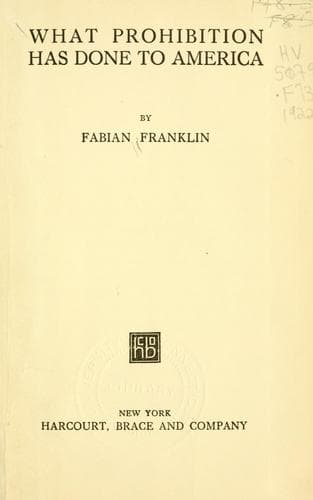
What Prohibition Has Done to AmericaFranklin, Fabian
History
What Prohibition Has Done to America
Franklin, Fabian
Prohibition -- United States; United States. Constitution. 18th Amendment
WELL MEANING exhorters, shocked at the spectacle of millions of
perfectly decent and law-abiding Americans showing an utter disregard
of the Prohibition law, are prone to insist that to violate this law,
or to abet its violation, is just as immoral as to violate any other
criminal law. The thing is on the statute-books--nay, in the very
Constitution itself --and to offend against it, they say, is as much a
crime as to commit larceny, arson or murder. But they may repeat this
doctrine until Doomsday, and make little impression upon persons who
exercise their common sense. The law that makes larceny, arson or
murder a crime merely registers, and emphasizes, and makes effective
through the power of the Government, the dictates of the moral sense
of practically all mankind; and if, in the case of some kindred
crimes, it goes beyond those dictates for special reasons, the
extension is only such as is called for by the circumstances. However
desirable it may be that the sudden transformation of an innocent act
into a crime by mere governmental edict should carry with it the same
degree of respect as is paid to laws against crimes which all normal
men hold in abhorrence, it is idle to expect any such thing; and in a
case where the edict violates principles which almost all of us only a
short time ago held to be almost sacred, the expectation is worse than
merely idle. A nation which could instantly get itself into the frame
of mind necessary for such supine submission would be a nation fit for
servitude, not freedom. But in the case of the Prohibition Amendment,
and of the Volstead act for its enforcement, there enters another
element which must inevitably and most powerfully affect the feelings
of men toward the law. Everybody knows that the law is violated, in
spirit if not in letter, by a large proportion of the very men who
imposed it upon the country. Members of Congress and of the State
Legislatures--those that voted for Prohibition, as well as those that
voted against it--have their private stocks of liquor like other
people; nor is there any reason to believe that many of them are more
scrupulous than other people in augmenting their supply from outside
sources. One of the means resorted to by the Anti-Saloon League in
pushing through the Amendment was the particular care they took to
make its passage involve little sacrifice of personal indulgence on
the part of those who were wealthy enough, or clever enough, to
provide for the satisfaction of their own desires in the matter of
drink, at least for many years to come. The League knew perfectly that
in some Prohibition States the possession of liquor was forbidden as
well as its manufacture, transportation and sale; but the AntiSaloon
League would never have dared to include in the Amendment a ban upon
possession. Congressmen who voted for it knew that not only they
themselves, but their wealthy and influential constituents, would be
Public-domain text, read in full here on John Shaqi.
Reviews
Reviews
No reviews yet
Be the first to share your thoughts on this work.
Join the Discussion
Join the discussion
Sign in to leave a comment or review.
Sign InorCreate an account