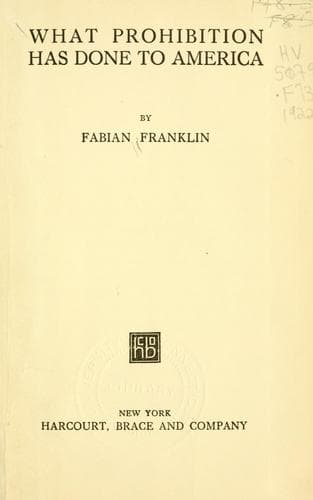
What Prohibition Has Done to AmericaFranklin, Fabian
History
What Prohibition Has Done to America
Franklin, Fabian
Prohibition -- United States; United States. Constitution. 18th Amendment
in a position to provide in very large measure for their own future
indulgences; and it may be set down as certain that had this not been
the case, opposition to the Amendment would have been vastly more
effective than it was. In order that a person should entertain a
genuine feeling that the Prohibition Amendment is entitled to the same
kind of respect as the general body of criminal law, it is
necessary--even if he waives all those questions of Constitutional
principle which have been dwelt upon in previous chapters--that he
should regard drinking as a crime. And this is indeed the express
belief of many upholders of the Amendment--a foolish belief, in my
judgment, but certainly a sincere one. I have before me a
letter--typical of many--published in one of our leading newspapers
and written evidently by a man of education as well as sincerity. He
speaks bitterly of the proposal to permit "light wines and beer," and
asks whether any one would propose to permit light burglary or light
arson. That man evidently regards indulgence in any intoxicating
liquor as a crime, and he looks upon the law as a prohibition of that
crime. And he is essentially right, if the law is right. For while the
law does not in its express terms make drinking a crime, its
intention--and its practical effect so far as regards the great mass
of the people--is precisely that. The people President Angell had in
mind when he implored the young Yale graduates not to be like them,
are not makers or sellers of liquor, but drinkers of it. They are not
moonshiners or smugglers or bootleggers; they are the people upon
whose patronage or connivance the moonshiners and smugglers and
bootleggers depend for their business. And everybody knows that, in
their private capacity, Senators and Representatives and
Legislaturemen are precisely like their fellow-citizens in this
matter. They may possibly be somewhat more careful about the letter of
the law; they are certainly just as regardless of its spirit. With the
exception of a comparatively small number of genuine
Prohibitionists--men who were for Prohibition before the Anti-Saloon
League started its campaign--they would laugh at the question whether
they regard drinking as a crime. And they act accordingly. What degree
of moral authority can the law be expected to have in these
circumstances? Upon the mind of a man intensely convinced that the law
is an outrage, how much impression can be produced by the mere fact
that it was passed by Congress and the Legislatures, when the real
attitude of the members of those bodies is such as it is seen to be in
their private conduct? How much of a moral sanction would be given to
a law against larceny if a large proportion of the men who enacted the
law were themselves receivers of stolen goods ? Or a law against
forgery if the legislators were in the frequent habit of passing
forged checks? It happens that the receiving of stolen goods or the
Public-domain text, read in full here on John Shaqi.
Reviews
Reviews
No reviews yet
Be the first to share your thoughts on this work.
Join the Discussion
Join the discussion
Sign in to leave a comment or review.
Sign InorCreate an account