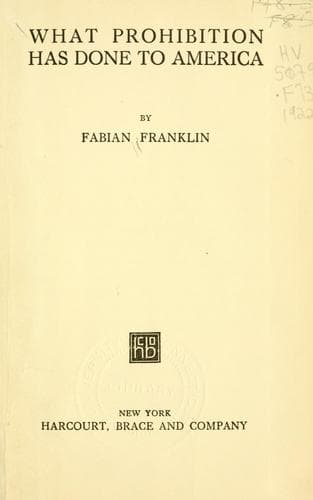
What Prohibition Has Done to AmericaFranklin, Fabian
History
What Prohibition Has Done to America
Franklin, Fabian
Prohibition -- United States; United States. Constitution. 18th Amendment
Liberty is not to-day the watchword that it was a hundred years ago, or
fifty years ago, or thirty years ago. Though there may be much doubt as
to the causes of the change, it must be admitted as a fact that the
feeling that liberty is in itself one of the prime objects of human
desire, a precious thing to be struggled for when denied and to be
jealously defended when possessed, has not so strong a hold on men's
minds at this time as it had in former generations.
Some of the chief reasons for this change are not, however, far to
seek. In the tremendous movement, political and economic, that has
marked the past hundred years, three ideas have been
dominant--democracy, efficiency, humanitarianism. None of these three
ideas is inherently bound up with the idea of liberty; and indeed each
one of the three contains the seed of marked hostility to the idea of
liberty. This is more true, and more obviously true, of efficiency and
of humanitarianism than it is of democracy; but it is true in no small
measure of democracy also. For people intent upon the idea that
government must be democratic that is, must reflect the will of the
majority naturally concentrate upon the effort to organize the majority
and increase its power; a process which throws into the shade regard
for individual rights and liberties, and even tends to put them
somewhat in the light of obstacles to the great aim. Furthermore, the
democratic movement has set for itself objects beyond the sphere of
government; and in the domain of economic control, democracy if that is
the right word for it must strive for collective power, as
distinguished from individual liberty, even more intently than in the
field of government.
However, in the case of democracy, there is at least no _inherent
opposition_ to liberty; such opposition as develops out of it may be
regarded as comparatively accidental. Not so with efficiency or
humanitarianism. Even here, however, I feel that a word of warning is
necessary. I am not speaking of the highest and truest efficiency, or
of the most far-sighted and most beneficent humanitarianism. I am
speaking of efficiency as understood in the common use of the term as a
label; and I am speaking of humanitarianism as represented by the
attitude and the mental temper of nearly all of the excellent men and
women who actually represent that cause and who devote their lives to
the problems of social betterment.
Public-domain text, read in full here on John Shaqi.
Reviews
Reviews
No reviews yet
Be the first to share your thoughts on this work.
Join the Discussion
Join the discussion
Sign in to leave a comment or review.
Sign InorCreate an account