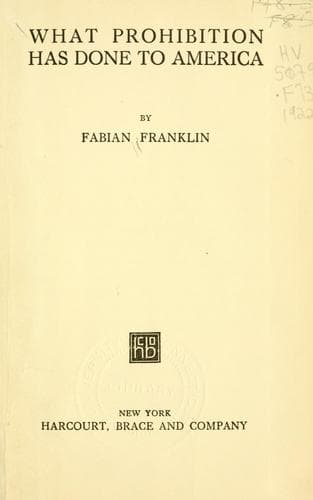
What Prohibition Has Done to AmericaFranklin, Fabian
History
What Prohibition Has Done to America
Franklin, Fabian
Prohibition -- United States; United States. Constitution. 18th Amendment
To the efficiency expert and to his multitude of followers, the
immediate increase of productivity is so absorbing an object that if it
has been attained by a particular course of action, the question
whether its attainment has involved a sacrifice of liberty seems to his
mind absolutely trivial. Of course this would not be so if the
sacrifice were of a startling nature; but short of something palpably
galling, something grossly offensive to the primary instincts of
freemen, he simply doesn't understand how any person of sense can
pretend to be concerned about it, in the face of demonstrated success
from the efficiency standpoint.
What is true of the apostle of efficiency, and his followers, is even
more emphatically true of the humanitarian. And, difficult as many
people find it to stand out against the position of the efficiency
advocate, it is far more difficult to dissent from that of the devotee
of humanitarianism. In the case of the first, one has to brace up one's
intellect to resist a plausible and enticing doctrine; in the case of
the second, one must, in a sense, harden one's heart as well as stiffen
one's mind. For here one has to deal not with a mere calculation of a
general increase of prosperity or comfort, but with the direct
extirpation of vice and misery which no decent person can contemplate
without keen distress. If the humanitarian finds the principle of
liberty thrust in the way of his task of healing and rescue, he will
repel with scorn the idea that any such abstraction should be permitted
to impede his work of salvation; and especially if the idea of liberty
has, through other causes, suffered a decline from its once high
authority he will find multitudes ready to share his indignation. And
he will find still greater multitudes who do not share his indignation,
and in their hearts feel much misgiving over the invasion of liberty,
but who are without the firmness of conviction, or without the moral
courage, necessary to the assertion of principle when such assertion
brings with it the danger of social opprobrium. The leaders in
humanitarian reforms, and their most active followers, are, as a rule,
men and women of high moral nature, and whether wise or unwise,
broad-minded or narrow and fanatical, are justly credited with being
actuated by a good motive; unfortunately, however, these attributes
rarely prevent them from making reckless statements as to the facts of
the matter with which they are dealing, nor from indulging in
calumnious abuse of those who oppose them. Hence thousands of persons
really averse to their programme give tacit or lukewarm assent to it
rather than incur the odium which outspoken opposition would invite;
and accordingly, true though it is that the idea of liberty is not
cherished so ardently or so universally as in a former day, the decline
into which it has fallen in men's hearts and minds is by no means so
great as surface indications make it seem. On the one hand, the
Public-domain text, read in full here on John Shaqi.
Reviews
Reviews
No reviews yet
Be the first to share your thoughts on this work.
Join the Discussion
Join the discussion
Sign in to leave a comment or review.
Sign InorCreate an account