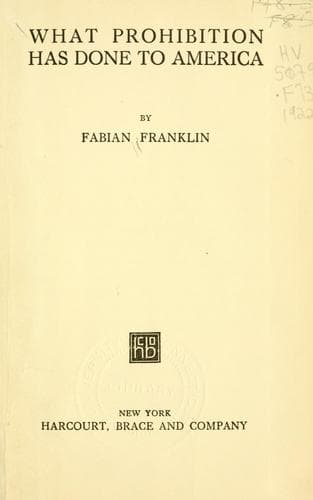
What Prohibition Has Done to AmericaFranklin, Fabian
History
What Prohibition Has Done to America
Franklin, Fabian
Prohibition -- United States; United States. Constitution. 18th Amendment
should fail actually to work so disastrous an injury to the cause of
liberty, we must thank the wide-spread and impressive resistance that
it has aroused. Had the people meekly bowed their heads to the yoke,
the Prohibition Amendment would furnish unfailing inspiration and
unstinted encouragement to every new attack upon personal liberty; as
it is, we may be permitted to hope that its injury to our future as a
free people will prove to be neither so profound nor so lasting as in
its nature it is calculated to be.
Before dismissing this subject it will be well to consider one favorite
argument of those who contend that Prohibition is no more obnoxious to
the charge of being a violation of personal liberty than are certain
other laws which are accepted as matters of course. A law prohibiting
narcotic drugs, they say, imposes a restraint upon personal liberty of
the same sort as does a law prohibiting alcoholic liquors. And it must
be admitted that there is some plausibility in the argument. The answer
to it is not so simple as that to the broader pleas which have been
discussed above. Yet the answer is not less conclusive. There is no
principle of human conduct that can be applied with undeviating rigor
to all cases; and indeed it is part of the price of the maintenance of
the principle that it shall be waived in extreme instances in which its
rigorous enforcement would shock the common instincts of mankind.
Illustrations of this can be found in almost every domain of human
action in the everyday life of each one of us, in the practice of the
professions, in the procedure of courts and juries, as well as in the
field of law-making. It is wrong to tell a lie, and there are a few
doctrinaire extremists who maintain that lying is not excusable under
any circumstances; but the common sense of mankind declares that it is
right for a man to lie in order to deceive a murderer who is seeking
his mother's life. Physicians almost unanimously profess, and honestly
profess, the principle that human life must be preserved as long as
possible, no matter how desperate the case may seem; yet I doubt
whether there is a single physician who does not mercifully refrain
from prolonging life by all possible means in cases of extreme and
hopeless agony. Murder is murder, and it is the sworn duty of juries to
find accordingly; yet the doctrine of the "unwritten law"--while
unquestionably far too often resorted to, and thus constituting a grave
defect in our administration of criminal justice--is in some extreme
cases properly invoked to prevent an outrage on the elementary
instincts of justice. In all these instances we have a principle
universally acknowledged and profoundly respected; and the waiver of it
in extreme cases, so far from weakening the principle, actually
strengthens it since if it absolutely never bent it would be sure to
break.
Public-domain text, read in full here on John Shaqi.
Reviews
Reviews
No reviews yet
Be the first to share your thoughts on this work.
Join the Discussion
Join the discussion
Sign in to leave a comment or review.
Sign InorCreate an account