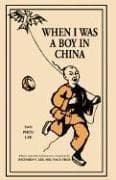
China -- Social life and customs -- 1644-1912; Lee, Yan Phou, 1861-1938?
I began to go to school at six. I studied first the three primers: the
_Trimetrical Classic_, the _Thousand-words Classic_, and the
_Incentive to Study_. They were in rhyme and metre, and you might
think they were easy on that account. But no! they were hard. There
being no alphabet in the Chinese language, each word had to be learned
by itself. At first all that was required of me was to learn the name
of the character, and to recognize it again. Writing was learned by
copying from a form written by the teacher; the form being laid under
the thin paper on which the copying was to be done. The thing I had to
do was to make all the strokes exactly as the teacher had made them. It
is a very tedious operation.
I finished the three primers in about a year, not knowing what I really
was studying. The spoken language of China has outgrown the written;
that is, we no longer speak as we write. The difference is like that
between the English of to-day and that of Chaucer’s time.
I then took up the _Great Learning_, written by a disciple of
Confucius; and then the _Doctrine of the Mean_, by the grandson of
Confucius. These text-books are rather hard to understand sometimes,
even in the hands of older folks; for they are treatises on learning
and philosophy. I then passed on to the _Life and Sayings of
Confucius_, known as the _Confucian Analects_ to the American
scholars. These books were to be followed by the _Life and Sayings
of Mencius_, and the _Five Kings_—five classics, consisting
of books of history, divination, universal etiquette, odes and the
_Spring and Autumn_, “a brief and abstract chronicle of the times”
by Confucius.
I had to learn all my lessons by rote; commit them to memory for
recitation the day following. We read from the top right-hand corner
downwards, and then begin at the top with the next line, and so on.
Moreover, we begin to read from what seems to you the end of the book.
All studying must be done aloud. The louder you speak, or shriek, the
more credit you get as a student. It is the only way by which Chinese
teachers make sure that their pupils are not thinking of something
else, or are not playing under the desks.
Now, let me take you into the school where I struggled with the Chinese
written language for three years. Oh! those hard characters which
refused to yield their meaning to me. But I gradually learned to make
and to recognize their forms as well as their names. This school was in
the ancestral hall of my clan and was like the one I have described.
There were about a dozen of us youngsters placed for the time being
under the absolute sway of an old gentleman of threescore-and-six.
He had all the outward marks of a scholar; and in addition, he was
cross-eyed, which fact threw an element of uncertainty into our schemes
of fun. For we used to like to “get ahead” of the old gentleman, and
there were a few of us always ready for any lark.
Public-domain text, read in full here on John Shaqi.
Reviews
Reviews
No reviews yet
Be the first to share your thoughts on this work.
Join the Discussion
Join the discussion
Sign in to leave a comment or review.
Sign InorCreate an account