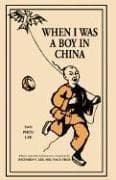
China -- Social life and customs -- 1644-1912; Lee, Yan Phou, 1861-1938?
It is six o’clock A. M. All the boys are shouting at the top
of their voices, at the fullest stretch of their lungs. Occasionally,
one stops and talks to some one sitting near him. Two of the most
careless ones are guessing pennies; and anon a dispute arises as to
which of the two disputants writes a better hand. Here is one who
thinks he knows his lesson and, having given his book to another,
repeats it for a trial. All at once the talking, the playing, the
shouting ceases. A bent form slowly comes up through the open court.
The pupils rise to their feet. A simultaneous salutation issues from a
dozen pairs of lips. All cry out, “_Lao Se_” (venerable teacher)!
As he sits down, all follow his example. There is no roll-call. Then
one takes his book up to the teacher’s desk, turns his back to him
and recites. But see, he soon hesitates; the teacher prompts him, with
which he goes on smoothly to the last and returns to his seat with a
look of satisfaction. A second one goes up, but poor fellow! he forgets
three times; the teacher is out of patience with the third stumble,
and down comes the ruler, whack! whack! upon the head. With one hand
feeling the aching spot and the other carrying back his book, the
discomfited youngster returns to his desk to re-con his lesson.
This continues until all have recited. As each one gets back to his
seat, he takes his writing lesson. He must hold his brush in a certain
position, vertically, and the tighter he holds it the more strength
will appear in his handwriting. The schoolmaster makes a tour of
inspection and sees that each writes correctly; writing is as great an
art in China as painting and drawing are in other countries and good
specimens of fine writing are valued as good paintings are here.
After the writing lesson it is time to dismiss school for breakfast. On
re-assembling, the lesson for the next day is explained to each one
separately. The teacher reads it over, and the pupil repeats it after
him several times until he gets the majority of the words learned.
He then returns to his desk and shouts anew to get the lesson fixed
in his memory. The more advanced scholars are then favored with the
expounding of Confucius’s _Analects_, or some literary essay.
After the teacher concludes, each is given a passage of the text to
explain. In this way, the meaning of words and sentences is learned,
and made familiar. The afternoon session is passed by the older pupils
in writing compositions in prose or in verse, and by the younger in
learning the next day’s task.
This is the regular routine, the order of exercises in Chinese schools.
Public-domain text, read in full here on John Shaqi.
Reviews
Reviews
No reviews yet
Be the first to share your thoughts on this work.
Join the Discussion
Join the discussion
Sign in to leave a comment or review.
Sign InorCreate an account