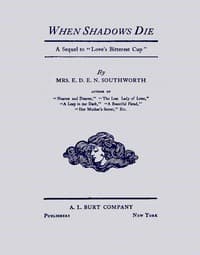
When shadows dieSouthworth, Emma Dorothy Eliza Nevitte
General
When shadows die
Southworth, Emma Dorothy Eliza Nevitte
American fiction -- 19th century
“I will tell you. You know, of course, that your wife is my heiress, and
if she survives me, will be my successor. Now, if you were an Englishman
you might get the reversion of your wife’s title.”
“I do not want it. I would not ask for it, nor even accept it.”
“That is your republican pride. Perhaps you are right. The old earldom
has fallen to the distaff at length, and it will be likely to stay there
for some generations to come; for Elfrida, who will be a countess in her
own right, has only daughters, which is a pity. And yet I don’t know—I
don’t know. If those fellows at Exeter Hall, and elsewhere, get their
way, in another century from this there will not be an emperor or a
king, to say nothing of a little earl, to be found above ground on the
surface of this fourth planet of the solar system commonly called the
earth, and their bones will be as great a curiosity as those of the
behemoth or the megatherium. Shall we have another game?”
And they played another, and yet another, game, in perfect silence,
interrupted only by the monosyllable ejaculations of technicalities
connected with their play.
The earl arose the winner; he often—not always—did. And so he was in
high spirits to welcome the return of the excursionists to dinner.
Another sad day of separation was drawing near. Le was to leave them on
the eleventh of October, giving himself twenty days in which to travel
from Baden-Baden, in Germany, to Washington, in the United States.
This was according to his uncle’s advice.
“You might stay here until the fifteenth, or even until the seventeenth,
and then reach Washington by the thirty-first; but it would, under the
most favorable circumstances, be so close a shave as to be perilous to
risk. An officer, nay, a man, may risk anything else in the world, Le,
but he must not risk his honor. You must report for duty at headquarters
punctually on the first of November, at any cost of pain to yourself or
to others.”
“I know it, uncle—I know it, and I will do my duty. Never doubt me.”
“I never do, my boy. And listen, Le. If you are prompt, as you are sure
to be, you may be able to obtain orders for the Mediterranean, and then,
Le, we shall see you again on this side. We will go to any port where
your ship may be.”
“Thank you, uncle. I shall try for orders to the Mediterranean. And I
think I shall get them. You see, I have been to the west coast of
Africa, and I have been to the Pacific Coast, and I really think I may
be favored now with orders to the Mediterranean. However, an officer
must do his duty and obey, wherever he may be sent—if it were to
Behring’s Straits!” concluded Le, with a dreary attempt at laughter.
When the day of parting drew very near, and the depressed spirits of the
lovers were evident to all who observed them, Mr. Force suddenly
proposed that he and his Odalite should accompany Le to the steamer and
see him off.
Public-domain text, read in full here on John Shaqi.
Reviews
Reviews
No reviews yet
Be the first to share your thoughts on this work.
Join the Discussion
Join the discussion
Sign in to leave a comment or review.
Sign InorCreate an account