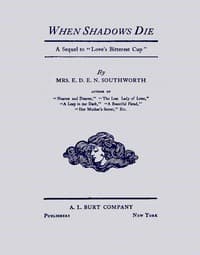
When shadows dieSouthworth, Emma Dorothy Eliza Nevitte
General
When shadows die
Southworth, Emma Dorothy Eliza Nevitte
American fiction -- 19th century
“Roland, my dear, is alive and well, but he does not know where you are
any more than Le does. We must find Le and let him know that we are
here,” said Mr. Force.
Then, with a total change of manner, he began:
“Come here, Odalite, my dear, and sit beside me. I have such good news
for you as shall give you patience to wait for Le, if he does not come
here for a week. But such news that, if he knew it, would bring him
within an hour!”
Full of vague expectancy, Odalite came and threw herself down on the
sofa beside her father, and looked up into his eyes.
“My dear Odalite, what would be the very best news that you could hear
to-day?” he inquired.
Odalite gazed into his eyes, too much excited to speak. Fearing, indeed,
to speak, lest his next words should disappoint her raised hopes, while
Mrs. Force and every occupant of the room, except the earl, waited
breathlessly.
“Oh, tell me, papa! tell me what you have to tell!” pleaded Odalite.
“Tell me, first, what would be the best news you could possibly hear
to-day?” persisted Abel Force.
His daughter gazed into his face, while her color went and came—came and
went; but she did not speak.
“Well, Odalite?” he inquired.
“Father,” she then answered, gravely, “the best news that I could hear,
that any of us could hear to-day, would be that the war was ended, the
country at peace, and the North and South friends again.”
“A conscientious reply, my dear. That would certainly be the best news
that any of us could hear. But it is not the news that I have to tell,
my love. Try again. My news is of a private nature, and concerns
yourself. What would be the best news that you could hear concerning
yourself?” persisted the squire.
“That I were free!”
The words came in a tone of impassioned aspiration that spoke volumes of
the suffering the girl had endured under the incubus that darkened and
oppressed her life.
“Then, my dear, hear it!” said the squire, earnestly.
“Odalite, you are free!”
“Father!”
The cry came from her soul, and it was echoed by her sisters and her
friend.
“Abel!”
This was from his wife.
“Yes, my dears, it is true!” replied the squire. “Odalite is free!”
“Anglesea is dead, then? Our terrible enemy is dead!” exclaimed Elfrida
Force, with a sigh of infinite relief.
“No, my dears, Anglesea is not dead, I thank Heaven! Long may that
gallant soldier and true gentleman live to enrich humanity! But your
enemy is dead to you, Odalite! You are free, my child! As free as either
of your sisters! And you have always been free, my dearest dear,
although I did not know it until to-day.”
“What is the meaning of all this?” demanded Elfrida Force, in a voice of
doubt and pain.
“Tell your sister, Enderby. Tell them all—and all about it! I cannot. I
am not equal to the task! I should talk like a fool!” said the squire,
drawing his handkerchief from his pocket, and wiping his brows.
Thus adjured, the earl looked around on the group of eager listeners,
and said, addressing Mrs. Force:
Public-domain text, read in full here on John Shaqi.
Reviews
Reviews
No reviews yet
Be the first to share your thoughts on this work.
Join the Discussion
Join the discussion
Sign in to leave a comment or review.
Sign InorCreate an account