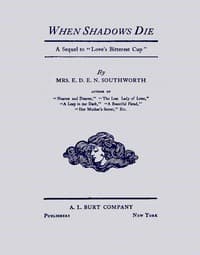
When shadows dieSouthworth, Emma Dorothy Eliza Nevitte
General
When shadows die
Southworth, Emma Dorothy Eliza Nevitte
American fiction -- 19th century
“You may remember, Elfrida, how amazed and incredulous I was when you
told me of the disgraceful career of one whom you called by the name of
my nearest and dearest friend—Angus Anglesea.”
“Yes! yes!” eagerly exclaimed the lady.
“And with good reason was I thus amazed and incredulous! To think a
gentleman of purest honor in one hemisphere should become an unmitigated
scoundrel in another, was simply impossible! I did not, and could not,
comprehend the enigma, and I did not try!”
“But sometimes you nearly lost your temper with us!” put in Mrs. Force.
“I did; because I thought you ought to have known my brother officer
better than to have believed him guilty of all the crimes of which he
was accused! Elfrida! I had forgotten one matter that might have cleared
up the mystery at once! And that matter was the existence of Byrne
Stukely.”
“‘Byrne Stukely!’ Who was he?” inquired Mrs. Force.
“He was the man who, under the name of Angus Anglesea, tried to marry
your daughter, but failed so signally that he has not even the shadow of
a shade of claim upon Odalite! She will not need the slightest action of
the law to free her from that incomplete ceremony begun in All Faith
Church! No, my dear; Odalite Force, as my brother-in-law has just said,
is as free as either of her sisters! Byrne Stukely has a wife and half a
dozen children, more or less, living in the town of Angleton, and
supported by the charity of Angus Anglesea!”
“But who then, in the name of Old Scratch, is this Byrne Stukely?”
demanded the irrepressible Wynnette.
“My dear, wait until I tell your mamma! Byrne Stukely is a distant—very
distant—relation of Angus Anglesea, and yet the two distant cousins
were, up to the age of twenty or thereabout, as much alike as twin
brothers. They must each have inherited the form, features and
complexion of some common ancestor; but there all the resemblance
between the men ended; for one inherited all the virtues of his
progenitors and the other all the vices! They were as opposite in
character as they were alike in form. This resemblance lasted, as I
said—lasted in its completeness—until the young men grew to be about
twenty years of age, when the character of each began to impress itself
upon his face, manner and expression. Anglesea developed into a man of
the highest and purest moral and intellectual excellence, and became a
Christian gentleman and soldier. Stukely sank down to the level of the
beasts, and below them—and became a bloated, brutalized criminal and
sensualist. No one, who has known both for the last twenty years, could
possibly mistake one for the other. Each has grown ‘into the likeness of
his spirit,’ and therefore they have grown far apart.”
“I ought to have known he was an impostor!” put in Wynnette. “I don’t
mind other people being deceived in the fellow! but for me—me—not to
know, the minute I saw the portrait of the real Col. Anglesea, that the
other fellow was a fraud!”
Public-domain text, read in full here on John Shaqi.
Reviews
Reviews
No reviews yet
Be the first to share your thoughts on this work.
Join the Discussion
Join the discussion
Sign in to leave a comment or review.
Sign InorCreate an account