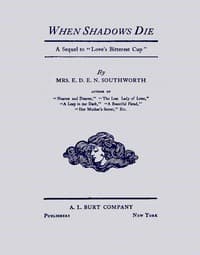
When shadows dieSouthworth, Emma Dorothy Eliza Nevitte
General
When shadows die
Southworth, Emma Dorothy Eliza Nevitte
American fiction -- 19th century
Le drew chairs around the table and invited his friends to be seated.
Then he went to the sideboard and brought forth a bottle of old port
wine, with wineglasses, and a box of choice Havana cigars, with wax
tapers, and putting them on the table, exclaimed, for the fourth time:
“What a surprise! I shall never get over this surprise!”
“You talk of surprises, Le!” said Mr. Force, when they had all had a
glass of wine around, and had lighted their cigars. “You talk of
surprises; but you ought to have grown hardened to them by this time! No
one could ever have had a greater one than you had when you found in the
pirate captain and his mate your old enemy, Angus Anglesea, and your old
friend, Roland Bayard!”
“You may well say that, uncle! But I do believe it was the sight of my
old foe that put the devil in me that day and made me utterly reckless
of my life in that fight.”
“We have all read of your heroism in action, Le, my dear boy, and we are
proud of you,” said the squire.
“It wasn’t heroism, uncle! It was diabolism! If ever the devil got into
mortal man he did into me that day! And it was all at the sight of
Anglesea.”
“No matter, the papers are full of the brilliant action, and you are the
hero of the hour.”
“Of the hour. You are right, uncle! Of the hour! In these days of
heroes—on both sides, mind, uncle—no one man, whatever his deeds, could
expect to hold public attention for a longer time. But, indeed—and there
is no mock modesty in what I say—I have no merit. I was more mad than
brave in that action.”
“Your captain, in his dispatches to the department, puts the case in a
better light. But let that pass for the present. Do you know who the
pirate really is?” demanded the squire.
“No more than that he is Capt. Silver, known to us as Col. Anglesea,”
said Le.
“He is neither entitled to the one name nor the other.”
“Neither Silver nor Anglesea? Who is he, then?” demanded the young
commander, in surprise.
“Enderby, dear fellow! You, who can speak with authority, tell Leonidas
who the man really is.”
The earl, thus entreated, turned to the young officer and told him the
story of Byrne Stukely, as it is already known to our readers.
Le listened with the closest attention, and at the close of the
narrative drew a deep sigh of relief and breathed forth a fervent
thanksgiving.
“And so you see by what Enderby has told you, that the rascal has not
now, nor ever has had, the slightest claim on the hand of Odalite, who
is now, and always has been, perfectly free. There is not even any need
to seek the aid of the law in her case,” said Mr. Force.
“Thank Heaven! Oh! thank Heaven!” again fervently exclaimed Le.
Then, after a pause, he asked:
“Uncle, when can I see Odalite?”
“As soon as you please, my boy!”
Public-domain text, read in full here on John Shaqi.
Reviews
Reviews
No reviews yet
Be the first to share your thoughts on this work.
Join the Discussion
Join the discussion
Sign in to leave a comment or review.
Sign InorCreate an account