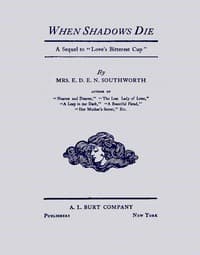
When shadows dieSouthworth, Emma Dorothy Eliza Nevitte
General
When shadows die
Southworth, Emma Dorothy Eliza Nevitte
American fiction -- 19th century
“I wish I could see her to-night But to-night duty holds me here.
Franklin, my second in command, has gone on shore for the first time to
see his family, who reside here, and whom he has not seen for three
years. So I cannot get off to-night! But early to-morrow! How early may
I see her to-morrow?”
“Come and breakfast with us at nine to-morrow. That is about as early as
we can manage.”
“I will go!”
“And now, Le, tell us about Roland Bayard. How comes it that he is in
the uniform of the pirate’s mate? How comes it that he is brought here
as a prisoner, instead of as a rescued captive?”
The countenance of the young man fell, all the joyous life died out of
it, and he murmured:
“I had forgotten! In my own selfish joy I had forgotten,’”
“Forgotten? What, Le?”
“I had forgotten Roland’s position. Oh, Uncle Abel! It is a most cruel
one!”
“Tell me one thing,” sternly demanded Mr. Force. “Was he Silver’s mate?”
“I do not know.”
“You do not know, Le? What do you mean by that? Surely you must know!”
“Indeed, I do not, uncle. After the fight was over, and when the two
prisoners were placed under my charge on board this ship, and she was
manned by a part of the crew from the _Eagle_, and I was ordered to take
her home, when we had set sail and were well on our way I went to see
Roland, to ask him some explanation of his presence on board the
blockade runner. He was not known there as Roland Bayard, but as Craven
Cloud. I found him alone, for the two prisoners had been confined
separately. I found him moody to the verge of melancholy madness. I told
him how grieved I was to find him there, and asked him to tell me how it
happened, when he had left Capt. Grandiere, whether he had joined the
navy and had been captured in some action.”
“And what did he reply to all these questions?” inquired Mr. Force,
seeing that Le paused in his narrative.
“Not one satisfactory word! He told me that fate had brought him there,
and that he could tell me no more. And though I plied him with
questions, and appealed to him to answer them in the name of our
lifelong love for one another, he remained obdurate. He assured me that
he could not satisfy me.”
“And he never did?”
“He never did. But one day he told me the reason why his tongue was
tied.”
“And what was that?”
“It was a terrible revelation, uncle—a terrible revelation! But it
accounted for everything that was strange in Roland’s life and conduct,”
replied Le, still shrinking from the utterance of what he had to say.
“Well, well, my boy?” demanded the squire.
“He told me that Capt. Silver was his own father!”
“Good Heaven!” exclaimed the earl.
The squire was silent for a moment, and then said, in the most emphatic
manner:
“I don’t believe it! It is not true!”
Public-domain text, read in full here on John Shaqi.
Reviews
Reviews
No reviews yet
Be the first to share your thoughts on this work.
Join the Discussion
Join the discussion
Sign in to leave a comment or review.
Sign InorCreate an account